
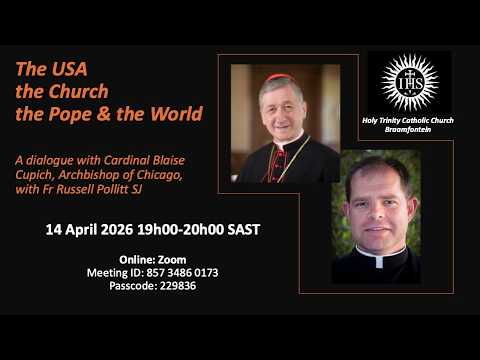
Fr Russell Pollitt SJ in conversation with Cardinal Blaise Cupich
Summary
Fr Russell Pollitt SJ opens the conversation by welcoming Cardinal Blaise Cupich and introducing his ecclesial background and leadership roles. They begin by discussing migration, with Cardinal Cupich describing the United States as an immigrant nation while also acknowledging the failures of a broken immigration system. He explains how anti-immigrant rhetoric has grown in the United States, how fear has been politically exploited, and how the Church in the US has been drawn together in opposing indiscriminate mass deportation and the inhumane treatment of migrants.
The conversation then turns to South Africa, especially the racial tensions surrounding the Trump administration’s openness to white Afrikaner asylum claims. Cardinal Cupich suggests that such policies reflect racialized narratives and ideas of cultural or racial purity. Fr Pollitt situates this in South Africa’s own painful history of apartheid and notes how false narratives continue to deepen divisions.
From there, the discussion broadens to war, especially the US and Israeli conflict with Iran. Cardinal Cupich argues that the war lacks a clearly defined just aim and therefore fails a central criterion of just war theory. He strongly criticizes the portrayal of war as entertainment and condemns the dehumanizing use of social media imagery that celebrates violence. He also rejects the use of Christian rhetoric to sacralize war, insisting that such appeals distort the Gospel and ignore the demands of peace, diplomacy, and human dignity.
A major thread throughout the interview is the role of Pope Leo. Cardinal Cupich reflects on the pope’s growing influence as a global moral voice and suggests that the papacy has become especially important in a time when other forms of political leadership seem morally diminished. He argues that many issues too easily dismissed as “political,” such as war, deportation, health care, budgets, and displacement, are in fact moral issues because they concern human dignity and flourishing.
The discussion also touches on tensions between the US bishops and the American administration, the need for Catholics to move beyond single-issue voting, and the importance of shaping political life not only by what one opposes but also by what one affirms. In response to questions from participants, Cardinal Cupich comments on Bishop Robert Barron, the distinction between morality and politics, resistance to MAGA politics, Israel and Lebanon, diplomacy, and Pope Leo’s visit to Africa.
In the latter part of the conversation, Cardinal Cupich reflects on the election of Pope Leo, describing the conclave as a deeply prayerful and liturgical process rather than a political contest. He also speaks candidly about the current English liturgical translations, describing them as clunky and overly tied to Latin syntax, and expresses openness to better translations and even to the creation of new vernacular prayers for the present age.
The interview closes with a more pastoral and ecclesial note. Cardinal Cupich says the Church must not be afraid to preach the Gospel boldly, especially in a world marked by fragmentation and fear. He emphasizes authenticity, particularly for younger people, and expresses hope that under Pope Leo, building on Pope Francis, the Church is entering a new era of missionary courage shaped by the joy of the Gospel.
Interview Transcript
Welcome and Introduction
Fr Russell Pollitt SJ:
Your Eminence.
Cardinal Blaise Cupich:
Sorry. Uh, my meeting that I had ran a little longer.
Fr Russell Pollitt SJ:
No problem. It’s very good to have you. Thank you so much for agreeing to meet with us here in South Africa. It’s been a long time, I think, since I saw you maybe 10, 12 years ago when I met you at the Family Synod. So it’s good to see you again and to have you with us.
So, welcome everybody. And just maybe to say that Cardinal Cupich is from Omaha, Nebraska. He was ordained to the priesthood for the Archdiocese of Omaha, but soon after ordination, in fact, was made a bishop of Rapid City in South Dakota by Pope John Paul II, and then he was appointed Bishop of Spokane in Washington by Pope Benedict in 2010, and Pope Francis asked him to be Archbishop of Chicago in 2014 and named him a cardinal in 2016. And he’s held numerous positions for the United States Conference of Catholic Bishops. He’s also a member of the Dicastery for Divine Worship and the Discipline of the Sacraments and the Dicastery for Culture and Education, and he is a well-known commentator on Church affairs. So we are very happy to have him with us.
Migration, Immigration, and the American Story
Fr Russell Pollitt SJ:
Your Eminence, I’d like to start by asking you to talk to us a little bit about the question of migration in our country. We receive many refugees, and we are ourselves very aware of xenophobia, which has reared its head in very violent ways in this country in the last 15 years. But where you come from, there are also many immigrants in Chicago. Can you say something about why people come to Chicago? Just give us some context of the immigrants in your part of the world.
Cardinal Blaise Cupich:
Well, I think first of all, it’s important to realize that we are an immigrant nation. The Native Americans were here first, and everyone else that’s here is by way of immigration. So that’s part of the character of who we are. Sometimes we forget that, and we’ve had moments in history of nativism that has protested the influx of immigrants, and we always seem to be able to come back to our understanding of who we are as an immigrant nation.
With regard to Chicago, you’re right, it is a place. It’s a city of immigrants. We celebrate Mass in 26 languages every weekend because of the diverse population that we have here. My grandfather, my dad’s father, came to the United States and started working here in Chicago in the stockyards and the packing houses, and then moved on to Omaha. So in many ways my family has roots here itself as a family of immigration.
A Broken Immigration System and Political Fear
Fr Russell Pollitt SJ:
Since January 2025, immigration has become a real hot issue in the United States, certainly from the perspective here in Southern Africa, and there’s been a very strong anti-immigrant message coming from the United States government. It’s been so strong that even it seems that people who were divided against each other within the Catholic Church now are talking off the same page. What has given rise to this anti-immigrant rhetoric that we so often hear coming out of the US?
Cardinal Blaise Cupich:
Well, part of it is that we have a broken immigration system, and so there was an influx of people coming across the southern border, and we really had uncontrolled migration of people that caught people off guard because we really didn’t have a system by which we could integrate them and also give them a path to citizenship.
Also, over time, it became clear that we had 11 million people here without documents who were in this country even though they were contributing much to the economy and to the life itself here in the United States. So I think that there were people who stoked fears that we were being overrun by a group of people from the south who didn’t speak English, who had a different culture. Some of that also had a criminal population, very few, of course. But it was due to the fact that our elected officials did not come up with an immigration policy and procedure that was fair to immigrants but also that protected our borders. So it was a storm, a perfect storm, that just came together in that period of time.
The Church’s Response to Mass Deportation
Fr Russell Pollitt SJ:
It’s not too unfamiliar to the situation here in Southern Africa. What you describe about a broken immigration system is very much, I think, part of the problem that we have here in South Africa. In a way, immigration has brought the leadership of the Church in the US together, which very often from our perspective as well seems to be quite divided, and especially maybe in the Pope Francis years. Do you feel that the Church has pulled together to stand up about this question of immigration?
Cardinal Blaise Cupich:
Well, I think when we had the administration with its crackdown on those who didn’t have documents, what we protested, and the statement we made last November, was the indiscriminate mass deportation of people, because all of those words were important in that sentence. It was indiscriminate, and it was a mass deportation in which people, no matter what their circumstances, could be torn apart from their families. Breadwinners who supported their families for years, maybe even started businesses and hired people, were just taken away from their communities and their families without a whole lot of process.
Also, we had people, in fact, who were in the queue for getting legal status with their green card who were picked up simply because they were still in the middle of the process rather than having it completed. So there was no rhyme or reason, and also the fact that people’s rights were being violated, their human dignity was being violated, as they were thrown to the ground and treated in a very inhumane way, something that Pope Francis and now Pope Leo, they both have commented on, the inhumane treatment of people. So that’s really what brought us together as an episcopal conference to make that very strong statement.
South Africa, Race, and the Afrikaner Asylum Controversy
Fr Russell Pollitt SJ:
So, Your Eminence, you describe there how people were in the process of getting status in the United States, et cetera, et cetera, and some of those people then ran into difficulties with the administration. For us sitting down here in South Africa, we had this very strange openness from the Trump administration to white South African Afrikaners getting asylum in the United States under the guise that there was a minority genocide, was the language that was sometimes used, and this also caused a lot of tension in our own country, some racial tension, because white people were being taken or allowed to go to the US. Do you have any idea what the thinking is behind that? Why is it that 99% of people taken to the US since the end of last year seem to be white Afrikaners? What is behind this? It’s quite difficult to understand.
Cardinal Blaise Cupich:
Well, I think it also has to be kept in mind that the government here has encouraged immigration from Scandinavian countries, from different parts of Europe, that seem to fit a profile that they’ve defined as important in order to protect the racial purity of this country. So it could be in line with that. I would also note that during the past election we saw language that went after Haitians who were living in Ohio, in which the presidential candidate, now president, said that they’re eating the dogs or eating the cats, in many ways degrading them as human beings. So I think that the narrative that was being projected here with regard to racial purity is really the foundation of the circumstance that you’re addressing here.
Racial Narratives and False Claims of Persecution
Fr Russell Pollitt SJ:
In a country like our own, we come from a very painful past of the system of apartheid. So this question of race, I think, is something that is always on our minds and certainly is still part of the struggle, even 30 years after the dawn of democracy in this country. So it is rather sad that we have moved into a democratic, working towards a non-racial society, but we still have places in the world where we seem to be slipping back again into these racial categories and putting people into those kinds of brackets.
Cardinal Blaise Cupich:
Well, I think the other part of it is that the claim was made that the white Afrikaners were in fact being persecuted and their rights being violated, and this is a way of saving them from an unjust system.
Fr Russell Pollitt SJ:
Yes, which over and over has been proved that that is not true for those of us who are living in this part of the world. This country has many problems, but certainly there is no persecution of any minority group per se. We have a very high crime rate. We have many other social ills, but it’s been really based on what one could say is a false narrative, as has been pointed out many times even by our own bishops’ conference here in South Africa. So, yeah, we are still so often stuck into the question of race when it comes to these issues.
War with Iran and the Failure of Just War Criteria
Fr Russell Pollitt SJ:
I want to ask you as well: the US and Israel have gone to war with Iran. There were a number of places that also were attacked before Iran. How much did race play, do you think, or do you think it was more economics in the decision to bomb Nigeria, Venezuela, and so on?
Cardinal Blaise Cupich:
I don’t see that as the case. I think that the war in Iran, in some ways, was due to the concern about a regime that was supporting and fostering terrorist activity in the Middle East. I think that the record’s clear in that, and also the way that they’re treating their own people, and also the way in which the whole Middle East is inflamed by the tensions between the Arabs and the Israelis.
But it’s clear to me, and my brother bishops, many of our brother bishops, that there really was no aim that was clearly defined of why we went to war. The motive changed all the time. It was whether or not it was nuclear weapons, or whether it was a matter of unconditional surrender, regime change, or now it’s the opening of the Strait of Hormuz, that there really wasn’t a goal. And that’s why, in terms of the just war theory, that criterion was not met, the reason for going to war that is going to then bring about justice and also peace. It’s very clear that this is a war of choice, not of necessity. And that’s, I think, where the emphasis has to be as we discuss this issue.
The Spectacle of War and the Dehumanization of Violence
Fr Russell Pollitt SJ:
You have been very strong on this issue, you and Cardinal McElroy of Washington, Cardinal Tobin of Newark. In fact, you even came out saying that you found it sickening the way that the government was portraying the war as some sort of game. So you have condemned this war that the US has entered into.
Cardinal Blaise Cupich:
Well, I think we’ve not only taken issue with the fact that we shouldn’t have gone to war, but I have condemned the portrayal of it as entertainment. What we see on the White House platform of social media is the splicing together of movie scenes with actual bombing of sites that kill people. And so the killing of people is celebrated as entertainment, even the killing of children and our own troops, then seems to dehumanize the human tragedy of war. And it became clear to me that something had to be said about that. So I wrote a couple of articles, one of them in the Washington Post, to call that out, and it was then brought up when we did the 60 Minutes interview Sunday.
Christian Nationalism and the Abuse of Religious Language
Fr Russell Pollitt SJ:
This war has also been framed in Christian nationalist terms. We’ve seen images on our TVs here of prayers being said, the Lord being asked to crush our enemies. What are your thoughts about the frequent use of scripture and Christian rhetoric by those who are leading this war?
Cardinal Blaise Cupich:
I think the Holy Father has spoken about this very clearly, that that’s an unacceptable way. Let’s remember, the God that we’re all called to worship is the one who we call Father, who defines us as brothers and sisters. God’s plan from the very beginning was that we live in harmony and build a society in which the rights of others would be respected and the circumstances would be fostered by which every human being can flourish. War tears that apart.
And so it’s used to justify military action when the attempts for negotiation, for diplomacy, have been jettisoned simply because, as the Holy Father said, there’s a zeal for war again. War is in vogue again.
Pope Leo, War, and the Moral Voice of the Papacy
Fr Russell Pollitt SJ:
The Holy Father, Pope Leo, is the first American pope. He is from your part of the world, and as you say, he’s been very strong about this question of war. He’s condemned war for a number of months, and violence and so forth. Is this message landing, do you think, with the people in the United States?
Cardinal Blaise Cupich:
I guess I am not a pollster. I can’t say that. But I do know that the majority of the American people are against the war. Polls have shown that. What impact the Holy Father is having is something yet to be measured. But I do know his image here and reputation is very strong. And so I think when he speaks, especially now in these days, people will take notice of it and look at it and have a discussion, not about the diversion that’s being made in name-calling, but rather the substance of what he’s saying.
The US Bishops and a Tense Political Climate
Fr Russell Pollitt SJ:
Has the relationship between the bishops in the US and the administration, the local bishops, has that become more difficult in the last six or seven months?
Cardinal Blaise Cupich:
Well, I think that it began, I think, when we in November criticized the way immigration enforcement was taking place, and now I think with the war, yes, I think it’s tense right now. And on the other hand, we should not shy away from it. We should speak the truth and preach the Gospel.
I was asked about would Catholics be upset that we are introducing politics in the life of the Church and in our liturgies, and I said it’s not about politics, it’s about the Gospel. That’s what we’re trying to preach here. And that doesn’t mean that we should hold back simply because people are thinking we’re entering into an area that politics wants to claim as its own. That’s a mistake, to cede that area simply to the political world. There is a moral framework that also has to be introduced. The language that’s being used now to defend the war is all about might makes right and that God is on our side. But there is another language that comes from the Gospel, the full Gospel, that we have to introduce in this discussion.
The Holy Father and the President
Fr Russell Pollitt SJ:
In the last 24 hours, 36 hours, we’ve seen the clash of this language between the Holy Father, who interestingly never really said anybody by name but certainly was calling out anybody who in any way was waging unjust wars, and the president of the United States, and we’ve had this played now for the last 24 hours on our TV here and so forth. What is your reading of this? How do you respond to the way the president responded to the Holy Father? And I guess people would also want to know about the image, the famous image that has now been taken down. Your thoughts on that?
Cardinal Blaise Cupich:
Well, I think with regard to the image, the fact that they took it down, they realized that this crossed the line with many people, and so I’m glad that they did. With regard to the remarks of the president with the Holy Father, I’ve encouraged the administration to take up the substance in discussion rather than creating a diversion if we’re to have any way forward. The way, the name-calling, the attempts to deride the Holy Father and characterizing him the way that they did is all a distraction. It’s a weak argument.
I remember from my first days of studying philosophy in my first year of college, the weakest argument is an ad hominem argument, and I think that that’s what we need to take into consideration at this moment.
Waking Up: Democracy and a Changing World
Fr Russell Pollitt SJ:
Friends, if you’d like to ask any questions, feel free to put them in the chat. Please keep yourself muted, and we will look at those questions.
The way that things are moving at the moment in the world, there seems to be a realignment of powers. Do you think we’re entering into a new world order, or do you think that maybe once the current crop of leadership has moved on, things will just continue to be as they were six, seven, eight, nine, ten months ago?
Cardinal Blaise Cupich:
Yes, I see some movement in the direction of people waking up and coming to an understanding that they have to become involved. I think that’s good for a democracy in the long run. I think there are some things that are being said and done that are so outrageous that it is shaking the conscience of people to become more active and engaged in what’s happening today.
So I think that especially in these last days, I’ve heard from a lot of people how stunned they are by the criticism of the Holy Father, but also the way that the war is being waged right now that is going to continue to have a profound impact on the social fabric of the world and the economic fabric of the world. So there are signs that people are really waking up right now about what’s happening.
The Papacy as a Global Moral Voice
Fr Russell Pollitt SJ:
It seems that Pope Leo is playing a very important role in helping people to wake up. We saw this with Pope Francis, I think, as well, that the pope has become more and more, perhaps in the last 10, 15 years, the moral voice in the world. We don’t have the kind of leaders maybe that we had 20, 30 years ago, and the papacy has become quite important as a global player. Do you think that’s correct?
Cardinal Blaise Cupich:
I do, and that’s why I think that it’s helping people imagine what morality is about. When people say that the Holy Father should stick to morality and not politics, what they’re really saying is that they’ve reduced morality, as Pope Francis once said, as those issues below the belt that have nothing to do with the way that people’s lives are being threatened.
And so it’s important, I think, to make sure that we understand when we speak about morality that we have an all-inclusive range of topics, that when we talk about killing people, mass deportation of people, indiscriminate bombing, ways in which people’s lives are displaced, they’re left homeless, they’re left without food and water because of military action, those are all moral issues. And for others to dismiss them solely as political issues without looking at a moral framework is a diversion and only helps those who want to close off discussion of those who raise moral issues about those topics.
Question from the Audience: Bishop Robert Barron and MAGA
Fr Russell Pollitt SJ:
Your Eminence, we have a question that’s come in that says, “Your opinion on Bishop Robert Barron and his seemingly friendly approach to MAGA.” I know that the bishop serves on the Religious Liberty Commission of the president. People seem to think at times that maybe he’s a bit too close to the president, although yesterday he did come out and condemn what the president said about the Holy Father. Would you like to offer an opinion on that?
Cardinal Blaise Cupich:
Well, he’s a native son of Chicago. He’s a priest of this archdiocese. He was a director of our seminary. A very bright individual who has a wide influence on people and does a lot of good. I know that he was invited, I think with Cardinal Dolan, to serve on this commission for religious freedom. It’s always good to accept the invitation to serve in some way in a government capacity as an adviser. We need to have that voice in there, and I was pleased that he told the president that he should apologize for his remarks about the Holy Father. And so I think it’s yet to see what kind of impact his voice will have with that request.
Morality, Politics, and Human Dignity
Fr Russell Pollitt SJ:
Someone else is asking, what is the difference between morality and politics?
Cardinal Blaise Cupich:
Well, I think morality begins, it’s anchored in the question of how is human dignity being protected and advanced. Whenever there is a threat to human dignity, to the rights of people, moral questions then are raised. So, for instance, outside of this question of war, health care, universal health care, is a part of protecting and making sure that human dignity flourishes, and as such it’s a moral issue.
The way that a country puts together its budget and finances, how it uses the resources that are available for the health, education, and welfare of its citizens, is a moral issue simply because it has to do with human dignity. So a political issue is one in which you look at the actual means by which that human dignity can be protected. And of course there are different ways in which that can be done. But if in fact on health care there’s a system by which people are systemically denied access to health care, then that political issue has to be evaluated from a moral framework simply because it can’t just be a matter of having a decision made in politics by the decision of the strongest or the wealthiest, but there has to be another question about whether or not human flourishing can take place as a result of those decisions.
Fr Russell Pollitt SJ:
What you say about health care also, sometimes when one listens to the issues that other nations face, we face exactly the same here in South Africa, how budgets are spent, how people are excluded. So these are really universal issues.
Beyond Anti-MAGA: What Are You For?
Fr Russell Pollitt SJ:
Someone’s asking how strong is the anti-MAGA movement, or MAGA movement, and where is the centre of resistance?
Cardinal Blaise Cupich:
So I guess I can’t say that for sure. I’m not in contact with people who define themselves as anti-MAGA. I do think, however, that there’s a lot of discussion today about people who want a different direction, that it’s not going to be sufficient to be just against something. People have to come out with an agenda for which they’re for something. And so, if you shrink the discussion in society to have it defined solely in terms of being against the incumbent power, then you’re going to close off the possibility of looking at more creative ways of moving forward as a country.
And I know that discussion’s taking place today. What you do is you allow those who are in power to define the terms of the debate when in fact you just have an anti- approach. I think that you’re going to be more successful in the long run if you say not what you’re against but what you’re for.
Moving Beyond Single-Issue Voting
Fr Russell Pollitt SJ:
Someone’s asking, which I guess is linked to this, how do you think US Catholics can be moved from single-issue voting towards voting for human rights, justice, and peace, given that 55% of US Catholics voted for Trump in the last election? I mean, we have that same sort of thing often in South Africa. Voting is often along racial lines. But how does one move people from this question of single-issue voting?
Cardinal Blaise Cupich:
Yes. You know, if there is a single-issue vote that gets people united in part with a particular candidate, so often unfortunately it’s only the economy, and I think a lot of people do vote with regard to the eyes of how things are going economically. Part of this issue too was the fear of immigration, as we saw that the border was not secured during the last administration, and so that was exploited very heavily.
I do think, though, that there is an openness on the part of Catholics to look at a whole range of issues that are important for a nation to consider, and we’ve seen that time and again, Catholics have had that perspective. So I think that it is important to keep that in mind. But I would say in this past election a lot of people voted for the economy, but also for the protection of the borders.
Israel, Lebanon, and the Need for Diplomacy
Fr Russell Pollitt SJ:
Someone’s asking about the morality of Israel’s violent attacks on Lebanon and forceful action in the West Bank. I suspect that your comment on that will be very much what Pope Leo has said about any sort of violence. Would you want to say something about that?
Cardinal Blaise Cupich:
Right. I think that Israel has been suffering from the bombardments and the attacks that come out of southern Lebanon, and that they do have a right to protect themselves. At the same time, when you take military action that displaces so many people and the bombings do not singularly target those that are combatants, but the general population, where women and children and non-combatants are killed, then that has to be called into question.
What the Church has always favored is having people sit down at the table and discuss these things, to look for a way in which diplomacy can be exercised. Unfortunately, with the Iran war now, with this other war, there has been no attempt to sit down and have a diplomatic approach. Yes, it takes more time. It’s painstaking. It takes patience. But in the long run, it proves to be more productive for peace. Peace cannot be imposed by dominance. It never works. But peace can come about when people do work out a framework diplomatically in order to solve the issues that are there.
Pope Leo’s Visit to Africa and the Global Church
Fr Russell Pollitt SJ:
Thank you. Someone is saying it seems really significant that the pope is in Africa right now, where the faith is growing rapidly. What do you, from the North American perspective, perhaps see as his hopes and intentions for this visit? It seems to be about peace and the peripheries, and how much do you think the dimension of interfaith is part of his agenda at the moment as he travels to those four countries on our continent?
Cardinal Blaise Cupich:
Well, I think it’s first of all important to keep in mind that when he was Robert Prevost, as the general superior of the Augustinians, he traveled around the world and in different parts of Africa. So this is territory familiar to him. And of course going to Hippo, where the great St Augustine was bishop, I think was important to him in many ways. So that was part of it.
He also has, as he said from the balcony the day he was elected on May 8th, a desire for peace in the world, and that peace also has to be among different faith traditions so that there is no exploitation of religion in order to create conflict in the world. And he also wants to make sure that the world draws its attention to countries that are still developing and need assistance. So all of those factors, I think, were part of his decision to make his first apostolic journey to those African countries.
What an American Pope Means
Fr Russell Pollitt SJ:
As someone who is living in the US, we now have an American. What does it mean for you as a Catholic in the United States that we have an American pope, where many people perhaps before the conclave would say, well, it will not be an American because you wouldn’t want the Vatican and the superpower in the world to be of one nationality. How is that for you?
Cardinal Blaise Cupich:
Well, of course that line of thinking has been undermined by the reality of what we’re seeing today in Pope Leo. Isn’t that true? And so I think that the cardinals did not look upon Robert Prevost as an American. He lived in Peru for 20 years. They saw him as a person who had dual citizenship. So it really wasn’t a factor, and that aspect of having an American in there for political reasons was never even considered. That had absolutely nothing to do with the election of Pope Leo.
What we did see in him, however, I think, is as we sat in the pre-conclave and talked about qualities that we thought the next pope should bring, he seemed to check all the boxes. He was a pastor. He spoke a number of languages. He had experience worldwide. He had management and administrative ability. He was also a missionary. So those qualities came together in one person, and that’s what I think is important to keep in mind.
During the conclave, contrary to a narrative that’s out there that a lot of politicking for one person or another really was a part of what we did, is absolutely false. What we really wanted to consider was what does the Church need right now in order to move forward, and I think once we got that picture in place, that’s why 133 people from 71 countries were able to come to a decision in less than 24 hours.
The Conclave as Prayer, Liturgy, and Discernment
Fr Russell Pollitt SJ:
Our own Archbishop Cardinal Stephen Brislin says that it was a very prayerful moment where he really sensed that the Spirit was moving when the cardinals came together. So it’s heartening to hear that.
Cardinal Blaise Cupich:
You know, one thing to keep in mind is that in the conclave we were in choir robes, we were in liturgical dress, because this was prayer for us. This was liturgy. This was worship of God that we undertook here. And it wasn’t just a political process, or it wasn’t a process of electing someone, but rather it was calling upon the Spirit of God, the Spirit of Christ, to inflame our hearts for love of the Church but also inform our minds about what the will of God was at this particular moment.
Rethinking the English Liturgical Translations
Fr Russell Pollitt SJ:
And I think from what we’ve seen so far, Pope Leo, you really did listen to the Holy Spirit when you came together.
A bit of a left-field question here is, is there any move in Rome to relook at the English translations we’ve used since 2010, perhaps to make them more fluid and proclaimable while maintaining the dignity of the liturgy?
Cardinal Blaise Cupich:
I’d be the first one to vote for that. I think the translations we have now are clunky. It was too tied to the Latin to make it cognate translations, and it just doesn’t seem to inspire. We need poets to help us with this translation, and that really is going to lift our hearts as we hear these prayers. Sometimes it’s very difficult, in fact, to pray them because we just don’t speak that way. The syntax is all wrong for ordinary speech.
Fr Russell Pollitt SJ:
Thank you.
Cardinal Blaise Cupich:
I’ll tell you a funny story. You know, we were told that we needed to have the consubstantial in the Creed. Huh? Remember that? Instead of one in being. So we asked, “What is consubstantial? How do we tell our people what does consubstantial mean?” Well, it means one in being. I said, “Yeah, but that’s what we’re saying already.”
And so a couple years after this translation came out, an 80-year-old man who went to church every day said, “You know, I don’t know what you bishops do all the time and do these translations, but,” he says, “what is his business in the Creed of Constantinople?”
So I think that I would be in favor of looking at that translation again. The other thing I’d be in favor of is why can’t we have in our own vernacular languages the possibility, not for all of the prayers but for some, to be able to create prayers for our own time in our own language that could also stand together with those of the ancient tradition? There’s no reason why we can’t in this time pray in a language and in a syntax and with the needs that we have before us and create prayers for this time.
Fr Russell Pollitt SJ:
There’s no official move at the moment, however, is there, to reconsider that translation?
Cardinal Blaise Cupich:
I’ve not heard of any, but I’ve advocated that for years. So I’m the lone voice in the desert.
Fr Russell Pollitt SJ:
From your mouth to God’s ears. I think that most people here would agree with you when it comes to the question of that translation.
The Church’s Mission in a Fractured World
Fr Russell Pollitt SJ:
Maybe, Your Eminence, as our time together draws to an end, is to ask you what your hopes would be for the Church in the next couple of years. What would you hope that the Church can do in this fractured world in which we live at the moment? And how do we begin to do that on a day-to-day basis? Because it’s very easy for us to sit and talk about systems of injustice and structures of injustice. How do we daily try to build a better world, better relationships, and deal with this fractured world and sometimes even fractured Church that we live in?
Cardinal Blaise Cupich:
I would say not to be afraid of the noble calling that is ours to preach the Gospel, because I know that that is the pathway forward for engaging people of goodwill in taking up the mission of Christ, especially young people. Young people are looking for authenticity. They’re looking for genuineness. They’re looking for a vision of life that’s much bigger than the demands sometimes that an individualism in our society puts on us.
So my hope would be that we would have the bravery and the courage to be true to the Gospel because that’s the pathway forward. That is what’s going to allow us to be successful in taking up the mission that the Lord gave the disciples from the very beginning. Time and again he said don’t be afraid, and sometimes we are fearful and hesitant to exploit the full meaning of the Gospel today. And I think under the leadership of Pope Leo, on the back and the shoulders of someone like Pope Francis, we have entered a whole new era in the life of the Church. We’re just beginning, I think, to tap into Evangelii Gaudium, the joy of the Gospel, that was really, I think, the magna carta for us to move forward.
Young Catholics, Tradition, and the Future of the Church
Fr Russell Pollitt SJ:
Someone has just asked me, you mentioned young people there. We also see a lot of young people are tending to want a more conservative sort of Catholicism, maybe returning even to the Tridentine liturgy. What are your thoughts around that?
Cardinal Blaise Cupich:
Well, I think there are some young people who tend towards that, but I would say they’re not large. We brought in over a thousand people into the Church this year in the archdiocese. I know other dioceses have done that too. And the demographic of post-college to 35 was the largest component, and they come to our Novus Ordo Masses and are intrigued by that. So I wouldn’t want to overplay too much that there are some young people who tend toward the older liturgy for one reason or another. The vast majority of the people who have come into the Church, however, understand that the renewal of the Second Vatican Council is where the Church should be.
Will Pope Leo Visit the United States?
Fr Russell Pollitt SJ:
Your Eminence, Pope Francis never returned to Argentina once he ascended the chair of Peter. Do you think Pope Leo will visit the United States? Do you think he will come home at some point and wave on the streets of Chicago?
Cardinal Blaise Cupich:
Oh, I hope so. And when that day comes, we’ll be ready for a big celebration here in the city, and we’ll demand lots of time, not just a day. We have to have him for a while because he’s our hometown boy that we want to celebrate.
Closing Blessing and Farewell
Fr Russell Pollitt SJ:
Thank you so much. I know that you’re a very busy man. Cardinal Blaise Cupich, thank you for your time. Thank you for being with us. Thank you for being open to having this dialogue. And we continue to hold you in prayer, as we often hear your voice, in fact, in the media, the English-speaking Church media in this part of the world, and we pray for you, and we pray most especially at this time as well for your country, as we ask you to pray for ours and also for our world. So really grateful to you for your time and for your insights today.
Cardinal Blaise Cupich:
A blessed Easter to all of you.
Fr Russell Pollitt SJ:
Thank you. God bless you. Thank you, everybody. Bye-bye.
Cardinal Blaise Cupich:
Bye-bye.