
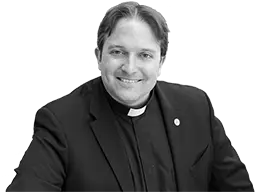
 Fr Matthew Charlesworth SJJesuit PriestSociety of JesusJesuit priest working in Southern AfricaFr. MatthewCharlesworthSJ
 Tuesday in the 33rd Week in Ordinary Time
Date: | Season: Ordinary Time after Easter | Year: A
First Reading: Revelation 3:1–6, 14–22
Responsorial Psalm: Psalm 15:2–4b, 5
| Response: Psalm 3:21
Gospel Acclamation: 1 John 4:10b
Gospel Reading: Luke 19:1–10
Preached at: the Jesuit Institute in the Archdiocese of Johannesburg, South Africa.
Most of us like to tidy the house before a visitor arrives. We put things away, clear the table and try to make ourselves a little more presentable. But the wonderful thing about Jesus in today’s readings is that he wants to come into our house before we have put everything in order. He comes not because everything is right, but because he loves us enough to help us put things right.
In the Book of Revelation, we encounter two Christian communities suffering from different kinds of spiritual illness. The people of Sardis have a reputation for being alive, but inwardly they are dying. The people of Laodicea have become so comfortable that they no longer recognise their need for God.
Both are dangers in the spiritual life. It is possible to be religious without being particularly open to God; to be busy with the things of God without spending much time with the God of all things. We can become so familiar with the language of faith that we lose our sense of wonder.
And yet, in the midst of this rather severe examination of conscience, we hear some of the most tender words in Scripture:
“I stand at the door and knock.”
God has not withdrawn his love. He is still calling us to repent and to share our lives with him. He promises to sit at table with whoever opens the door.
Today’s Gospel brings that promise to life in the encounter between Jesus and Zacchaeus.
There is something rather touching about the sight of Zacchaeus, a wealthy, powerful, grown man climbing a tree. Beneath his wealth, his social position and his public reputation, there is a longing that perhaps even he cannot fully explain.
He wants to see Jesus.
But the great surprise of the Gospel is that Jesus wants to see him.
Imagine the scene. The dust of the road, the noise of the crowd, the branches of the sycamore tree. Suddenly Jesus stops, looks up and calls Zacchaeus by name.
The crowd calls him a sinner. Jesus calls him by name.
And notice the urgency in the words of Jesus: “Hurry and come down, for I must stay at your house today.”
Before Zacchaeus has made restitution or promised to change his life, Jesus offers him his friendship.
Grace comes first.
Perhaps this is something worth remembering during these days of retreat. Whether we are making our first eight-day retreat or have been making retreats for forty years, we do not have to manufacture a spiritual experience. We do not have to impress God with the quality of our prayer. We do not even have to know precisely what we are looking for.
We can begin by allowing ourselves to be looked upon with love.
So much of our lives is spent trying to earn the love that God gives us freely. We sometimes imagine that we must become better people before we can allow ourselves to be loved. But the Gospel suggests that it is precisely the experience of being loved that gives us the courage to change.
Jesus’ welcome does not leave Zacchaeus unchanged; it gives him the freedom to change. He offers half his possessions to the poor and promises to repay fourfold anyone he has cheated.
His encounter with Jesus reaches all the way into his pocket.
This is where today’s psalm becomes particularly important. The person who dwells in the presence of God is someone who speaks the truth, does no harm to their neighbour, lends no money at interest and refuses to accept bribes against the innocent.
Authentic prayer has social consequences.
In our own part of the world, where many families struggle to put food on the table, where young people struggle to find employment, and where corruption so often comes at the expense of service delivery for the poorest, we cannot separate our love of God from our responsibility towards one another.
The silence of a retreat should make us more attentive to the cries of those whom society does not hear.
St Elizabeth of Hungary, whom we remember today, understood this. The daughter of a king, she founded a hospital and spent the last years of her life caring for the sick and sitting beside the dying.
Her privilege became an opportunity for service rather than an excuse for indifference. The hands that had once enjoyed the comforts of a royal court now tended the wounds of the poor.
St Ignatius invites us in the Spiritual Exercises to ask for an intimate knowledge of Jesus, so that we may love him more deeply and follow him more closely.
For those of us who are Jesuits, this means allowing Christ to draw us away from our own importance, our own interests and our own plans, so that we may become more freely available for his service.
And for all of us, the fruit of a retreat is not necessarily that we leave with wonderful experiences of prayer, but that we leave with hearts more capable of loving.
Perhaps, during these days, we might place ourselves in the Gospel scene, among the branches of that sycamore tree. Imagine Jesus stopping, looking up and calling us by name. Notice the expression on his face. Listen to the sound of his voice. Stay for a while with the joy of being wanted by God.
And perhaps we might carry three questions into our prayer this evening:
- What is the deepest longing beneath all my other desires?
- What within me am I still reluctant to open to Christ?
- What might need to change in my life if I were to respond fully to his love?
Here, in this Eucharist, the Lord who stands at the door and knocks is the same Lord who invites us to his table.
Let him love us into becoming the people we are called to be.
For you have come on retreat to seek God, only to discover that God has been seeking you all along.
Source: https://sj.mcharlesworth.fr/homilies/2026-11nov-17-ya-ot-33/
This homily is shared for personal and pastoral use. Please attribute the author and do not alter the meaning when quoting. If you wish this homily to be translated - there is an option on the website which will allow you to translate it into the language of your choice.
Licenced under a Creative Commons Attribution-NonCommercial-NoDerivatives 4.0 International (CC BY-NC-ND 4.0) license.
The author does not speak for the Society of Jesus or for the Catholic Church.





In preparing this homily, I consulted various resources to deepen my understanding of today’s readings, including using Magisterium AI for assistance. The final content remains the responsibility of the author.