
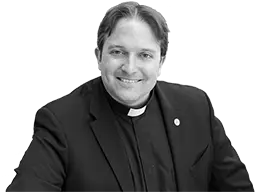
 Fr Matthew Charlesworth SJJesuit PriestSociety of JesusJesuit priest working in Southern AfricaFr. MatthewCharlesworthSJ
 33rd Sunday in Ordinary Time
Date: | Season: Ordinary Time after Easter | Year: A
First Reading: Proverbs 31:10–13, 19–20, 30–31
Responsorial Psalm: Psalm 128:1–5
| Response: Psalm 128:1a
Second Reading: 1 Thessalonians 5:1–6
Gospel Acclamation: John 15:4a, 5b
Gospel Reading: Matthew 25:14–30
Preached at: the Jesuit Institute in the Archdiocese of Johannesburg, South Africa.
When we come to the end of our lives, perhaps the most important question will not be how much we accomplished, but how much life we made possible for others. Who found courage because we encouraged them? Who discovered God because we walked with them? Who had a little less to fear because we had the courage to love them?
All of our readings today speak to us about what we do with the life entrusted to us.
The Book of Proverbs concludes with a remarkable portrait of a woman. In Hebrew, she is described as Eshet Chayil, a woman of valour. The Hebrew word carries associations of strength and courage and is even used elsewhere in Scripture to describe mighty warriors. Yet here there is no battlefield, no sword, no great military victory. Instead, there is a woman working with wool and flax, providing for her household and extending her hands to the poor.
The biblical author invites us to reconsider what constitutes heroism.
There is heroism in the mother who rises before dawn to provide for her children; in the teacher who refuses to give up on a difficult pupil; in the nurse who treats a forgotten patient with tenderness; in the religious who patiently accompanies someone whose problems seem never to end.
These are victories for which the world seldom awards medals.
To this day, in many Jewish homes, these verses from Proverbs are sung on Friday evenings as families gather to celebrate the Sabbath. There is something beautiful about setting aside time at the end of a busy week to honour the often unseen work of those who hold our lives together.
And notice the hands of this woman. The same hands that work the spindle reach out to the poor. Her industry does not end in her own prosperity. Her goodness spills over into the lives of others.
The Psalm develops this image. It speaks of a fruitful vine, of young olive shoots gathered around a table, and of enjoying the fruits of one’s labour. There are no palaces, no treasures, no monuments to personal greatness. There is simply a home in which life is growing.
Perhaps that is as good a measure as any of the success of our Jesuit communities. Are people growing in our midst? Are our brothers becoming more fully themselves? Are those who come to us finding nourishment, encouragement and a sense of belonging?
We must be careful that, in our desire to do great things for God, we do not neglect the small things through which God does great things.
In the Gospel, Jesus tells us about three servants who are entrusted with their master’s wealth.
A talent was an enormous sum. Even the servant who received only one had been entrusted with a fortune
Nobody in this story was given nothing.
But we must remember that the talents belong to the master. The parable is not simply about developing our abilities. It is about our responsibility for everything God has placed in our care: our faith, our freedom, our relationships, our possessions, our opportunities and the Gospel itself.
It is a story about accountability, but it begins with trust.
And perhaps the most encouraging figure in the parable is the second servant. He does not possess the impressive resources of the first. But neither does he allow another man’s gifts to diminish his appreciation of his own.
When the master returns, both servants receive exactly the same words of praise. Both are invited into the same joy.
God does not ask the second servant why he is not the first.
Why, then, do we spend so much of our lives wishing to be somebody else?
While we are busy comparing ourselves with others, we may be neglecting the very gifts through which God wishes to reach the world.
The third servant explains his conduct in three simple words: ‘I was afraid.’
His failure lies not simply in being afraid. We all experience fear. His failure lies in allowing his fear to become a reason for refusing responsibility.
We recognise something of ourselves in this man. We fear failure, criticism, embarrassment and rejection. We sometimes prefer the certainty of a protected life to the uncertainty of a generous one. And we can become remarkably skilled at disguising our fears as prudence, humility or even fidelity to tradition.
We can spend an entire lifetime digging a very respectable hole.
Notice the contrast between the woman in Proverbs and the servant in the Gospel. The woman’s fear of the Lord leads her towards wisdom, generosity and faithful service. The servant’s fear leads him towards distrust and withdrawal.
One opens her hands; the other closes his.
Much of our spiritual life depends upon the image of God we carry within us.
If I believe that God is merely waiting for me to make a mistake, I will spend my life trying not to make one. But if I trust in God’s love, I can find the courage to serve, even when success is uncertain.
And Christian fruitfulness is not the same as worldly success.
There may come a time when age or illness takes away many of the abilities upon which we have relied. We may no longer be able to teach, preach, travel or undertake demanding apostolic work.
But we can still love. We can still pray. We can still listen. We can still rejoice in the goodness we see in others.
Our lives remain fruitful—not only through what we can do, but through the love and presence we continue to give. And sometimes we help someone else do what we ourselves can no longer do.
Immediately after this parable, Matthew gives us the scene of the final judgement. And there Jesus makes clear that our response to him is revealed in whether we fed the hungry, welcomed the stranger, clothed the naked and visited the sick.
There is an enormous difference between living a life that avoids doing wrong and living a life that actively does good.
In our country we know something of the terrible waste of human potential. Think of the intelligent child whose family cannot afford an education; of the gifted young person who cannot find employment; of those whose abilities go unused because they lack the right connections.
How much wisdom, creativity and goodness never see the light of day because someone was never given a chance?
A society, too, can be guilty of burying talents.
Our Christian responsibility is not simply to use our own gifts, but to help build a society in which others have the opportunity to use theirs.
For us as Jesuits, this is also part of understanding the Ignatian magis. It is not about becoming more impressive, more influential or more accomplished. It is about becoming more available to God and more generous in love.
Towards the end of the Spiritual Exercises, St Ignatius asks us to consider how much God has given us. Only then does he invite us to consider what we might give in return.
Love, he reminds us, ought to manifest itself more in deeds than in words.
And so we pray:
‘Take, Lord, and receive all my liberty, my memory, my understanding and my entire will.’
Everything we offer to God is something we have first received from God. Even our generosity begins in his generosity.
St Paul reminds the Thessalonians that the Day of the Lord will come like a thief in the night. But he also reminds them that they are children of the light.
Last Sunday, Jesus asked us to keep our lamps burning. Today, he asks us to make good use of the time those lamps give us.
We prepare for eternity not by anxiously counting the days that remain, but by filling the days that remain with love.
Every act of mercy, every reconciliation, every courageous decision for justice brings something of God’s promised future into the present.
And so, in our prayer this week, perhaps we might ask ourselves:
- What have I buried through fear?
- Whose gifts am I being called to help flourish?
- What am I still reluctant to give back to God?
And when the Lord finally comes, may he find us with our sleeves rolled up and our hands open. May he find us with less buried in the ground and more planted in the hearts of others.
For the greatest tragedy would not be to arrive before God with empty hands because we had given everything away.
It would be to arrive with full hands because we had never learnt to give.
Amen.
Source: https://sj.mcharlesworth.fr/homilies/2026-11nov-15-ya-ot-33/
This homily is shared for personal and pastoral use. Please attribute the author and do not alter the meaning when quoting. If you wish this homily to be translated - there is an option on the website which will allow you to translate it into the language of your choice.
Licenced under a Creative Commons Attribution-NonCommercial-NoDerivatives 4.0 International (CC BY-NC-ND 4.0) license.
The author does not speak for the Society of Jesus or for the Catholic Church.





In preparing this homily, I consulted various resources to deepen my understanding of today’s readings, including using Magisterium AI for assistance. The final content remains the responsibility of the author.