
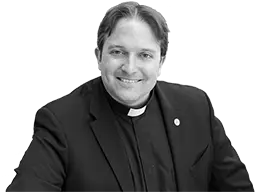
 Fr Matthew Charlesworth SJJesuit PriestSociety of JesusJesuit priest working in Southern AfricaFr. MatthewCharlesworthSJ
 30th Sunday in Ordinary Time
Date: | Season: Ordinary Time after Easter | Year: A
First Reading: Exodus 22:20–26
Responsorial Psalm: Psalm 18:2–4, 47, 51
| Response: Psalm 18:2
Second Reading: 1 Thessalonians 1:5c–10
Gospel Acclamation: John 14:23
Gospel Reading: Matthew 22:34–40
Preached at: Our Lady of the Wayside Parish, Mount Pleasant in the Archdiocese of Harare, Zimbabwe.
Imagine a poor man standing outside a house as the sun begins to set. He is waiting for someone to return his cloak. It is the only covering he owns. He has borrowed money and offered the cloak as security because he has nothing else to give. The lender has a legitimate claim, but the man outside faces a cold night.
And God gives a command: return his cloak before sunset. What else will he sleep in?
What a remarkable thing for God to be concerned about! Of all the great matters in the world, God notices a poor man who might spend the night shivering in the cold.
And perhaps that is the heart of tonight’s readings. God does not ask for obedience that leaves compassion outside. He wants to know whether our obedience has made room for the person standing outside in the cold.
Justice begins here, in refusing to stop caring for one another. The poor man’s immediate need takes precedence over the lender’s right to keep the cloak overnight.
In our first reading, God commands Israel not to oppress the foreigner, mistreat the widow or orphan, or exploit the poor. And God promises to hear their cry because He is compassionate.
God reminds Israel that they too were once strangers in Egypt. They knew what it meant to be powerless and unwanted. Their own suffering was meant to teach them compassion.
Surely this speaks to us in Zimbabwe. We know families struggling to pay school fees, young people unable to find work, elderly parents depending on their children, and people working hard but still unable to make ends meet.
Some may be sitting among us this evening, and we may not know what burdens they carry.
The danger is that we become so accustomed to hardship that we stop noticing the person who suffers. Poverty becomes a statistic. Another appeal for help becomes an inconvenience.
But God never becomes accustomed to human suffering. He still hears the cry. He still notices the person standing outside in the cold.
And this concern does not end at our doorstep or our country’s borders. Think of civilians caught in wars, in Gaza and elsewhere, especially children. The international community has affirmed a principle called the Responsibility to Protect: each state has the primary responsibility to protect its own population from genocide, war crimes, ethnic cleansing and crimes against humanity. When a state is unable or unwilling to do so, the international community must not simply look away, but seek a lawful response—including diplomacy and other forms of collective action—to protect civilians and pursue peace. This does not mean that every conflict calls for military intervention. It means that the suffering of innocent people cannot be dismissed as none of our concern. The God who hears the cry of a poor man without his cloak also hears the cry of a child without a home.
Our psalm gives us the other side of this relationship: “I love you, Lord, my strength.” David calls God his rock, his fortress, his refuge. These are the words of someone who has known danger but discovered that God has not abandoned him.
We love because we have first been loved.
Think of your own life. Perhaps a parent sacrificed for you, a teacher believed in you, or a friend stood beside you in difficult times. Perhaps you remember a moment when you thought you could not go on, yet somehow God’s grace carried you through.
When we pray, “I love you, Lord, my strength,” we remember that we too have stood outside in the cold, and someone opened the door.
Then comes today’s Gospel. A scholar of the Law asks Jesus, “Teacher, which commandment in the Law is the greatest?”
Jesus brings together two ancient commandments: “Love the Lord your God with all your heart, with all your soul and with all your mind,” and “Love your neighbour as yourself.”
Jesus will not let us separate them. Love of neighbour is a concrete sign of our love for God.
Jesus does not abolish the Law. He reveals its heart. Love does not cancel the commandments. It shows us what they are for.
And here is the challenge. Jesus does not make the Law easier. He makes it more demanding.
We can keep a rule and still be cruel. We can come to Mass every Sunday and still refuse to forgive someone. We can pray faithfully and still treat people in our homes without patience or respect.
We can sometimes use rules to excuse ourselves from love. But Jesus will not let us use the Law that way.
Perhaps this is where the Gospel becomes uncomfortable. We can be very good at loving people in general. We want peace, justice and dignity for everyone. But sometimes the hardest person to love is the person living in our own house.
The husband who does not listen. The wife who feels unappreciated. The teenager who thinks nobody understands. The elderly parent who repeats the same story. The neighbour whose behaviour irritates us.
It is easy to speak about loving humanity. It is harder to love the particular human being God has placed beside us.
Of course, love does not mean accepting mistreatment or agreeing with everyone. Sometimes it requires an uncomfortable truth, a firm boundary, or the courage to defend someone suffering injustice. True love seeks the other person’s good, never their humiliation.
St Ignatius of Loyola reminds us that love must be shown more in deeds than in words.
And that brings us to the second reading.
Paul praises the Thessalonians because they became imitators of him and of Christ. They received the Gospel amid suffering, yet with joy, and their example inspired others.
There is a beautiful chain of imitation. Paul follows Christ. The Thessalonians follow Paul. Others learn from them. Their faith spreads, not because life has become easy, but because their hope and love remain visible even when life is hard.
And that is how faith is passed on.
Children learn love by watching their parents. Young people learn faith by watching adults. An elderly person praying through illness teaches trust. A religious sister quietly caring for the sick makes God’s compassion visible without preaching a sermon.
Someone is learning what Christ looks like by watching us.
Elsewhere, at the Last Supper, Jesus gives this love its fullest measure: “Love one another as I have loved you.”
Not simply as you love yourself. As I have loved you.
He loved us when we failed, when we turned away, when we had nothing to offer. He loved the disciples who abandoned him and prayed for those who crucified him. He gave His life for us.
We cannot love like that by our own strength alone. We need God’s grace, His forgiveness, and the Eucharist.
In a few moments, we shall receive the Body of Christ. We come with empty hands, and God gives us Himself. We come with our failures, and God offers us mercy. We come hungry, and Christ gives us the Bread of Life.
Having received such love, how can we refuse to share it?
Perhaps this week we might return in prayer to the scene with which we began.
Imagine the evening sun going down. Feel the cold air. See the poor man waiting outside for his cloak.
Now imagine Jesus standing beside you, looking at that man. Perhaps He turns towards you and asks one simple question:
“Whose cloak are you holding?”
Let us ask ourselves this week in our prayers:
- Where have I been more concerned with being right than with being loving?
- Who is standing outside in the cold, waiting for something I can give?
- What one act of love will I undertake this week to make Christ’s compassion visible?
May someone, through what we do this week, discover that God has heard their cry.
Amen.
Source: https://sj.mcharlesworth.fr/homilies/2026-10oct-25-ya-ot-30/
This homily is shared for personal and pastoral use. Please attribute the author and do not alter the meaning when quoting. If you wish this homily to be translated - there is an option on the website which will allow you to translate it into the language of your choice.
Licenced under a Creative Commons Attribution-NonCommercial-NoDerivatives 4.0 International (CC BY-NC-ND 4.0) license.
The author does not speak for the Society of Jesus or for the Catholic Church.





In preparing this homily, I consulted various resources to deepen my understanding of today’s readings, including using Magisterium AI for assistance. The final content remains the responsibility of the author.