
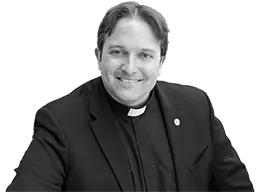
 Fr Matthew Charlesworth SJJesuit PriestSociety of JesusJesuit priest working in Southern AfricaFr. MatthewCharlesworthSJ
 28th Sunday in Ordinary Time
Date: | Season: Ordinary Time after Easter | Year: A
First Reading: Isaiah 25:6–10a
Responsorial Psalm: Psalm 23:1–6
| Response: Psalm 23:6cd
Second Reading: Philippians 4:12–14, 19–20
Gospel Acclamation: Ephesians 1:17–18
Gospel Reading: Matthew 22:1–14
Preached at: Our Lady of the Wayside Parish, Mount Pleasant and the Chapel of Emerald Hill Children’s Home in the Archdiocese of Harare, Zimbabwe.
Today’s Gospel follows on from last week’s — the one about the wicked tenants. Jesus is becoming even more direct in the way he makes his point.
A wedding is a joyous occasion for any family, and when it is a royal wedding, the whole kingdom has reason to celebrate. But something strange happens in today’s Gospel. Those first invited refuse to come. So the king sends his servants into the streets to invite everyone they can find.
God’s generosity is on display in all our readings today. Isaiah tells us that God will prepare a great feast for all peoples. St Paul reminds the Philippians that God will provide for their needs. And in the Gospel, the servants gather everyone they can find, both bad and good.
God is generous. Astonishingly generous. But what does this generous invitation ask of us? That, I think, is the important question in today’s Gospel.
Jesus is not simply telling a story about a wedding. He is speaking about the coming of the Messiah, challenging religious leaders who refuse to recognise what God is doing. But this is not a condemnation of the Jewish people. It is a warning to every generation, including us. We too can become so certain that we are right that we fail to recognise what God is asking of us.
And the Good News is that the invitation goes out to everyone. Think of those who responded to Jesus: tax collectors, prostitutes, the poor, the blind and the lame, people who had been excluded or made to feel they were not good enough. They discovered that God’s invitation was for them too.
And think about what makes a wedding such a wonderful occasion. It is not really the food or expensive clothes. It is the people: family and friends, young and old, sometimes even people who do not get along, all sharing the same celebration. That gives us a glimpse of God’s kingdom.
But true hospitality means more than opening the door. It means making people feel they belong and treating them with dignity. An invitation is not truly generous if people are welcome only as long as they know their place, keep quiet, or serve those in power. God calls us not only to accept his welcome, but to welcome others as he welcomes us.
And yet, being welcomed is not the end of the story. We come to that strange ending of the parable, when a guest is found without a wedding garment. Isn’t it odd that, in a story about a wedding, it is not the bride’s dress that matters, but a guest’s?
The Gospel does not explain why the man is without it. But the wedding garment has traditionally been understood as a sign of the life God asks us to live — the change that his grace makes possible.
We cannot earn an invitation to God’s feast. It is freely given. But neither can we accept it and behave as though nothing is expected of us. God gives us the help — the grace — we need to change. Grace comes first and makes our response possible; our part is to respond freely.
Remember, the servants gathered everyone, both bad and good. We are not invited because we have already become holy. We are invited so that, with God’s help, we might be transformed.
God loves us as we are, but that does not mean he wants us to remain exactly as we are. Love wants the best for the person who is loved.
Think of Zacchaeus, the tax collector who had cheated people. Jesus welcomed him, and that encounter changed his life. Zacchaeus promised to give to the poor and repay those he had cheated. Jesus’ welcome led him to repent and put right what he had done wrong.
That is what God’s love does. It reaches us where we are, but it does not leave us there.
One insight of Ignatian spirituality is that, when we look honestly at our deepest desires, we can begin to recognise what God wants for us. Not everything we want is good for us, of course. We must learn the difference. But God wants us to live fully, to love others, and to grow in our relationship with him.
Sin damages those relationships, but never stops God from loving us. Forgiveness, however, is not permission to carry on doing wrong. Real repentance means recognising the harm we have done, trying to put things right, and changing our lives.
That is the point of the wedding garment. God’s kingdom is one where love, justice, truth and mercy reign. Everyone is invited, but we cannot bring dishonesty, cruelty and injustice into that kingdom as though they do not matter.
Being Christian means trying to become more like Christ. Of course, we will fail. That is why we need God’s mercy. The danger is when we make excuses for what is wrong, or convince ourselves that Jesus would approve of what contradicts his teaching. Instead of allowing the Gospel to change us, we try to change the Gospel to suit ourselves.
But surely love, justice, truth and mercy must shape not only our personal lives but also our public life: the way we govern, the laws we make, and the way we treat the vulnerable.
We have had a timely reminder of this in Friday’s announcement that South Africa’s Navi Pillay has been awarded the 2026 Nobel Peace Prize. This is good news for our region, and for everyone who believes in human rights, the rule of law and the dignity of every person.
From opposing apartheid to working in international courts, Pillay has insisted that justice must apply to everyone. No one, however powerful, should be above the law.
And surely this speaks to us here in Zimbabwe. We see struggles within the ruling party, tensions between the President and his deputy over political succession and the Constitution, and, following Wicknell Chivayo’s death, continuing questions about wealth, political influence and accountability.
These are not simply questions about who should govern us, but about the sort of society we are building. Is the law there to protect everyone, or to serve those who hold power and wish to keep it? Are our institutions there to uphold justice, or to protect privilege?
Perhaps many people already know the answers, but are afraid to say them aloud. They know that speaking the truth can carry a personal cost, and that the law does not always protect those who need it most.
We should not be too quick to demand courage from people who have every reason to be afraid. Instead, we should ask why they must be afraid, and why those entrusted with protecting people so often fail to do so.
God’s invitation calls everyone to change. But those who hold authority have a particular responsibility, because their decisions affect others, especially those with the least power to defend themselves.
The wedding garment is not something we put on only when it suits us. It is the life of love, justice, truth and mercy we are called to live every day as people made new in Christ. It means recognising others as fellow guests at God’s table, not outsiders who must earn their place. It must shape our private lives, our public responsibilities, and the society we build together.
So let us ask ourselves today:
- Where is God inviting me to change?
- Where am I making excuses for something I know is wrong?
- Where might God be asking me to act with greater honesty, justice, courage or mercy?
We gather around the table of the Lord, a foretaste of the great feast to which God invites everyone. We do not come because we are perfect or have earned our place. We come because God is generous and merciful.
Let us ask for the grace to respond to his invitation, to clothe ourselves in love, justice, truth and mercy, and to become the people God has created us to be.
Amen.
Source: https://sj.mcharlesworth.fr/homilies/2026-10oct-11-ya-ot-28/
This homily is shared for personal and pastoral use. Please attribute the author and do not alter the meaning when quoting. If you wish this homily to be translated - there is an option on the website which will allow you to translate it into the language of your choice.
Licenced under a Creative Commons Attribution-NonCommercial-NoDerivatives 4.0 International (CC BY-NC-ND 4.0) license.
The author does not speak for the Society of Jesus or for the Catholic Church.





In preparing this homily, I consulted various resources to deepen my understanding of today’s readings, including using Magisterium AI for assistance. The final content remains the responsibility of the author.