
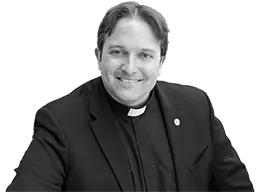
 Fr Matthew Charlesworth SJJesuit PriestSociety of JesusJesuit priest working in Southern AfricaFr. MatthewCharlesworthSJ
 Feast of the Ascension of the Lord
Date: | Season: Easter | Year: A
First Reading: Acts 1:1–11
Responsorial Psalm: Psalm 47:2–3, 6–9
| Response: Psalm 47:6
Second Reading: Ephesians 1:17–23
Gospel Acclamation: Matthew 28:19a, 20b
Gospel Reading: Matthew 28:16-20
Preached at: the Chapel of Emmaus House in the Archdiocese of Harare, Zimbabwe.
Brothers,
The Ascension tells us something simple and strong: Jesus does not leave the earth behind. He takes our life into the heart of God, and He leaves His blessing in our hands.
For many years, that blessing took the form of active ministry. Distances travelled. Doors opened. Sermons prepared. Confessions heard. Classes taught. Sickbeds visited. Funerals prayed. Young people guided. Poor families received. Many small acts of service no one recorded, but God remembers.
Now, for many here, the form has changed. The road is shorter. The day is quieter. The body asks for more care. But the mission has not ended. It has gone deeper. The hand may do less. The heart may carry more.
The Church still needs you. The Society still needs you. The people you served still need you. Now you carry them before God.
In the Acts of the Apostles, the disciples stand looking into the sky. We can understand them. They have lost Jesus once. They have received Him back in glory. Now He is taken from their sight. Their hearts must have been full.
Then the angels ask, “Why are you standing there looking into the sky?”
It is not a command to stop praying. It is a command to understand prayer. Christ is not gone. He is no longer present in one place only. He is present to every place: every chapel, every hospital ward, every lonely room, every frightened family, every dying person, every poor man or woman whose name the world forgets.
The Ascension is not about absence. It is about a wider presence.
The disciples are no longer only followers. They are witnesses. And witness does not end when public ministry ends. A witness is someone whose life still says: I have trusted Him, and He has not failed me. I have known mercy, and mercy is real. I have seen enough sorrow to know that God is not an idea. He is faithful.
Saint Ignatius teaches us that love must show itself in deeds. But deeds change with the season of life. Once, love may mean travelling, preaching, teaching, building, leading. Now love may mean sitting quietly with a rosary. Remembering names. Offering pain without bitterness. Blessing the young without envy. Praying for the Church, the Pope, the Society, and this wounded world with patient love.
That is not a smaller ministry. It may be one of the purest.
Psalm 47 sings, “God goes up with shouts of joy; the Lord goes up with trumpet blast.” But Christ does not reign like the rulers of this world. He does not rule by noise, threat, or force. He reigns with wounded hands. He is seated at the right hand of the Father, and there He intercedes for us. He does not crush the weak. He raises them. He does not forget suffering. He carries it into the Father’s heart.
So when we pray for those who are sick, ill, and dying, we are not speaking into emptiness. Christ is already present to them in his Church by the Holy Spirit, in his Word, in the Church’s prayer, and most especially in the Eucharist. When we pray for their families, tired from waiting, afraid of bad news, holding vigil by the bedside, Christ is already there. When we pray for our benefactors, living and dead, those whose quiet generosity helped carry the mission, Christ already knows their names.
No prayer is wasted. No hidden offering is small. No old servant of God is useless in the Kingdom.
Saint Paul prays that the eyes of our hearts may be enlightened. That is the prayer we need. We can look at age and see only loss. We can look at weakness and see only decline. We can look at silence and think nothing is happening.
But faith sees more.
Faith sees intercession. Faith sees wisdom. Faith sees a life still bearing fruit. The roots of a tree are hidden, but they hold the tree upright. A lamp may burn low, but it still gives light. The prayer of an old Jesuit may be unseen, but it can help hold up the Church.
The Society needs that hope. The Church needs it. Zimbabwe needs it. Not noisy hope. Not cheap hope. But hope with names, faces, and memories. Hope that forgives old wounds. Hope that blesses the next generation. Hope that prays when it can no longer run.
Pope Leo has spoken of an “unarmed and disarming” peace. That phrase belongs here. Christ told Peter, “Put your sword back into its sheath.” His peace is not weak. It is brave enough to refuse revenge, bitterness, pride, and fear.
Perhaps this is one of the great ministries of later life: to become men of disarming peace. Men who no longer need to win every argument. Men who lay down old battles. Men whose words calm a room. Men whose silence is not cold, but kind, and whose humour helps others breathe again. Men who can bless the future without needing to control it.
Pope Leo has also reminded the Church that human faces and voices must never be lost. That speaks directly to prayer. In prayer we do not carry vague crowds before God. We carry people. The sick friend. The dying brother. The anxious family. The faithful benefactor. The young Jesuit finding his way. The parishioner who once asked for counsel. The poor person whose story stayed with us. The world may turn people into numbers, images, opinions, or problems. Prayer gives them back their faces.
In the Gospel, Jesus opens the minds of His disciples. Then He blesses them. Then He is taken from their sight. And they return with joy.
That joy is the key. They do not return as men abandoned. They return as men entrusted. Christ is no longer before their eyes, but He is not absent. He is present in the Spirit. Present in the Eucharist. Present in the Scriptures. Present in the poor. Present in the sick. Present in the Church at prayer. Present in this altar where He gives Himself to us again.
So let us stand with them for a moment, as Ignatius would invite us to do. See the hill. See the Lord. See His wounded hands lifted in blessing. Hear the silence after He is taken from sight. Then hear the question: “Why are you standing there?”
Why stand there as if the mission were over?
Why stand there as if prayer were a small thing?
Why stand there as if hidden love could not help the Church?
There are sick people to carry before God. There are dying people to commend to mercy. There are families to strengthen. There are benefactors to bless. There are young Jesuits to support. There is the Society to place, day after day, into the hands of Christ.
The Ascension does not mean Jesus has gone away. It means He has gone ahead. Ahead of our fear. Ahead of our weakness. Ahead of our old age. Ahead of our country’s troubles. Ahead of our death.
And from there, He draws us forward.
So let no man here think his quieter years are empty years. The seed is hidden before it grows. The roots are buried before the tree gives shade. The prayer of a faithful servant may be unseen, but heaven sees it, the Church needs it, and Christ receives it.
He has not left us.
He has lifted us.
He has blessed us.
He has trusted us.
And now He asks us to pray, to bless, and to love until the end.
- Where am I tempted to think my mission is over, when Christ may be asking me to serve now through prayer?
- Whose face and name should I carry before God this week: among the sick, the dying, their families, our benefactors, and the Society?
- What would an “unarmed and disarming” peace look like in my words, my memories, my prayers, and my heart?
And so we place these names, these faces, and these lives into the hands of the Lord who has gone ahead of us, seated at the Father’s right hand, and who intercedes constantly for us until he comes again.
Source: https://sj.mcharlesworth.fr/homilies/2026-05may-17-ya-et-07/
This homily is shared for personal and pastoral use. Please attribute the author and do not alter the meaning when quoting. If you wish this homily to be translated - there is an option on the website which will allow you to translate it into the language of your choice.
Licenced under a Creative Commons Attribution-NonCommercial-NoDerivatives 4.0 International (CC BY-NC-ND 4.0) license.
The author does not speak for the Society of Jesus or for the Catholic Church.





In preparing this homily, I consulted various resources to deepen my understanding of today’s readings, including using Magisterium AI for assistance. The final content remains the responsibility of the author.