
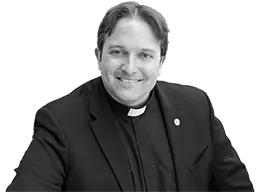
 Fr Matthew Charlesworth SJJesuit PriestSociety of JesusJesuit priest working in Southern AfricaFr. MatthewCharlesworthSJ
 6th Sunday of Easter
Date: | Season: Easter | Year: A
First Reading: Acts 8:5–8, 14–17
Responsorial Psalm: Psalm 66:1–7, 16, 20
| Response: Psalm 66:1
Second Reading: 1 Peter 3:15–18
Gospel Acclamation: John 14:23
Gospel Reading: John 14:15–21
Preached at: the Chapel of Emmaus House in the Archdiocese of Harare, Zimbabwe.
Jesus says today, “I will not leave you orphaned.” That is the promise at the centre of the Gospel. He is preparing his disciples for his departure, and he knows their hearts are troubled. They have lived with his presence, his voice, his friendship. Now he tells them that he will not leave them alone. He will give them the Holy Spirit, the Advocate, the Spirit of truth, who will remain with them.
But Jesus also says something sobering. The world cannot receive this Spirit, because it neither sees him nor knows him. The Spirit does not usually come with noise or force. He comes quietly. He speaks gently. He leads patiently. And so if we are too caught up in the world’s habits, its restlessness, its anxiety, its need to control, we may not hear him. The world says, “Act now, secure yourself, make things happen.” The Spirit often says, “Be still. Trust. Listen. Wait.”
And in this Gospel Jesus makes one thing very clear. Love for him is not simply a feeling. “If you love me, you will keep my commandments.” Again he says, “Whoever has my commandments and keeps them, that is the one who loves me.” Love becomes concrete in obedience. It becomes visible in fidelity. It shows itself in patience, truthfulness, charity, and perseverance. In religious life especially, love is often shown not in grand gestures but in steady faithfulness to the ordinary demands of the day, in prayer, in community, in kindness, in endurance.
Saint Peter adds another note. He tells us always to be ready to give a reason for the hope that is in us. But he also tells us how: with gentleness and reverence, and with a clear conscience. That is important. Christian hope is not harsh. It is not defensive in a proud way. It is quiet, truthful, and humble. We are not asked to force faith on anyone. We are asked to witness to hope with the manner of Christ himself.
And Peter roots all this in the Lord’s own suffering: Christ suffered once for sins, the righteous for the unrighteous, to bring you to God. That is the deepest ground of our hope. We do not hold ourselves together by our own strength. We are not saved by our good record. We are brought to God by Christ. He has gone before us. He has carried the burden of sin and suffering. He has opened the way. That is why hope remains possible, even when age brings weakness, even when perseverance has been costly, even when the road has been long.
The first reading gives us a living picture of what the Spirit does. Philip goes to Samaria, a place marked by division and suspicion, and the Gospel is welcomed there. People are healed. People are freed. And Saint Luke tells us, “There was great joy in that city.” That joy leads us straight into today’s psalm: “Cry out with joy to God, all the earth.” “Let all the earth worship you and sing praise to you.” The mark of God’s presence is not only that wounds are tended, but that joy begins to rise again. Not a noisy excitement, but that feeling of deep joy, the joy that comes when the Lord has not rejected our prayer and has not withheld his mercy.
Perhaps that is the word many older hearts need today. The Lord has not left us orphaned. He has not withdrawn his Spirit. He has not ceased to dwell with his people. Even when strength is less, even when the body is frail, even when our service feels hidden, the Spirit is still given. The call is still the same: to love Christ by keeping his commandments, to listen for the Spirit’s quiet guidance, and to remain within the hope that Christ has opened for us by his suffering and rising.
So the invitation this morning is simple. To become quieter before the Lord. To ask more often for the Holy Spirit. To let our love be shown in faithful obedience. To speak of our hope with gentleness and reverence. And to trust that Christ has indeed brought us to God, and will not abandon us now.
For our prayer this week let us ask ourselves:
- Where is the Lord asking me not simply to feel love, but to show it by keeping his commandments?
- How often do I ask the Holy Spirit, quietly and simply, to guide my thoughts, words, and decisions?
- Can others see in me the hope of Christ, spoken with gentleness, reverence, and a clear conscience?
Source: https://sj.mcharlesworth.fr/homilies/2026-05may-10-ya-et-06/
This homily is shared for personal and pastoral use. Please attribute the author and do not alter the meaning when quoting. If you wish this homily to be translated - there is an option on the website which will allow you to translate it into the language of your choice.
Licenced under a Creative Commons Attribution-NonCommercial-NoDerivatives 4.0 International (CC BY-NC-ND 4.0) license.
The author does not speak for the Society of Jesus or for the Catholic Church.





In preparing this homily, I consulted various resources to deepen my understanding of today’s readings, including using Magisterium AI for assistance. The final content remains the responsibility of the author.