
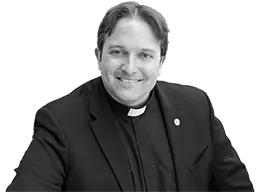
 Fr Matthew Charlesworth SJJesuit PriestSociety of JesusJesuit priest working in Southern AfricaFr. MatthewCharlesworthSJ
 4th Sunday of Lent
Date: | Season: Lent | Year: A
First Reading: 1 Samuel 16:1b, 6–7, 10–13a
Responsorial Psalm: Psalm 23:1–6
| Response: Psalm 23:1
Second Reading: Ephesians 5:8–14
Gospel Acclamation: John 8:12
Gospel Reading: John 9:1–41
Preached at: the Chapel of Emmaus House in the Archdiocese of Harare, Zimbabwe.
Today the Church does something beautiful in the middle of Lent. She tells us to rejoice. Laetare Sunday is not a break from repentance, but a light set within it. The rose colour, the gentler tone, the old cry Laetare Jerusalem, “Rejoice, Jerusalem,” all say the same thing: take heart. The road is still long, but Easter is drawing near, and Christ has not stopped coming toward us. We rejoice, not because life is easy, but because God has not given up on us. We rejoice because the Lord still sees what we do not see, and still teaches us to see.
That is the thread running through all the readings. In the first reading, Samuel goes to anoint a king. He sees the strong sons, the impressive sons, the obvious candidates. But God stops him: man looks on the outward appearance, but the Lord looks on the heart. David, the one God chooses, is not even in the room. He is outside with the sheep. Forgotten by others, but not by God.
That is how God works. He passes over the cultivated image and goes to the heart. He sees the hidden person, the longing beneath the failure, the courage beneath the fear. Most of us live under the pressure of appearances. We are judged by what can be seen quickly. God sees more deeply, and because he sees more deeply, he loves more truly.
Then the Gospel gives that truth a face. Jesus sees a man blind from birth. Others see a problem, a puzzle, a case to discuss. The disciples ask, “Who sinned, this man or his parents?” We still ask that question in other forms. Who is to blame? What did they do wrong? We often explain suffering because we do not want to come close to it.
But Jesus does not begin with blame. He begins with presence. He sees not first a sinner, nor an object lesson, but a person. Before he heals the man, he honours his dignity. In a world where many are looked at but not really seen, that matters.
Then Jesus makes mud and places it on the man’s eyes. It takes us back to Genesis, to God shaping Adam from the dust of the earth. This is not just a cure. It is new creation. Jesus is not simply correcting a defect. He is remaking a life.
Then he sends him to wash in the pool of Siloam. That is why the Church gives us this Gospel during the Scrutinies. Mud and washing, darkness and light, blindness and sight all point toward baptism. For the catechumens, this is their story. Christ meets them in their darkness, leads them to the water, and opens their eyes. But it is our story too. Baptism is not just something that happened once. It is a way of living. It is a call to walk in the light.
That is why Saint Paul says in today’s second reading, “You were darkness once, but now you are light in the Lord.” He does not say we merely lived in darkness. He says we were darkness. The trouble was not only around us. It was in us. Pride, resentment, fear, dishonesty, selfishness, the habit of hiding. But now, in Christ, we are light in the Lord. And Paul makes it practical: “the effects of the light are seen in complete goodness and right living and truth.” Light becomes visible in a life that is honest, merciful, and free.
This is also where we can say something simple about belief. In the Gospel, the blind man comes to belief step by step. At first he only knows that something happened. Then he says Jesus is a prophet. At the end he says, “Lord, I believe,” and he worships. Belief here is not guesswork, and it is not switching off the mind. It is trust born from encounter, and then deepened by thought. Faith seeks understanding.
That matters in this Gospel, because the Pharisees are not simply foolish men. They are trying to defend something real. They want to honour the law and keep faith pure. But they cling to a smaller truth and miss the greater one standing before them. They care for the law, but miss the law’s fulfilment. They defend purity, but fail in mercy. They guard the Sabbath, but do not recognise the Lord of the Sabbath.
So the irony increases. The man born blind begins to see more and more clearly, while the men who insist that they see become more and more blind. The healed man starts with very little, but he tells the truth: “I was blind and now I can see.” He does not have a neat argument. He has an encounter. And that encounter changes him.
There is another important detail. Once the man comes into the light, life does not become easier. He is questioned, mocked, and cast out. But then Jesus hears that he has been driven away, and Jesus goes to find him. That is the heart of the Gospel. Jesus does not heal him and then leave him alone. He seeks him out in the aftermath, in the loneliness, after the rejection. That is how the Lord acts with us too.
And perhaps that matters for us. In communities marked by weariness, suspicion, division, and quick judgement, Christ still passes by and asks us to see again. To see the overlooked. To see the poor without blaming them. To see our own motives more honestly. To see the neighbour we have reduced to a label. To see the greater truth when we have been clinging to the smaller one.
That deeper sight also means seeing more truthfully. In our current moment, we must learn to see the true cost and senselessness of war. Beneath the banners and speeches lie shattered lives, hungry families, wounded minds, and graves that never should have been filled. And those wounded by war can themselves become half-blind, seized by hatred, prejudice, and the desire to avenge what they have lost. But the Gospel calls us to something greater: to see clearly enough to choose peace, forgiveness, and reconciliation. War is always a failure of our humanity, and every Christian is called to be a servant of peace. For peace does not happen by itself. It needs peacemakers, people willing to resist hatred, speak truth, bear suffering, and rebuild trust.
So today, in the middle of Lent, the Church asks us to rejoice because Christ still opens blind eyes. He still sees the forgotten. He still chooses the unlikely. He still brings people out of darkness into light. He still remakes lives with the patience of a creator and the tenderness of the good shepherd, who leads us, restores our soul, and brings us home.
And so perhaps our prayer today can be very simple: Lord, let me see. Let me see myself truthfully, without fear. Let me see other people mercifully, without prejudice. Let me see where I have mistaken part of the truth for the whole. Let me see you, standing before me, speaking my name, leading me into light.
For this is our joy: not that we already see clearly, but that Christ is light enough for our darkness, mercy enough for our sin, and truth enough for our lives. He who found the blind man can find us too. And when he does, our only real answer is the answer of that man: Lord, I believe.
- Where in my life am I still blind, not because God is absent, but because I do not want to see?
- Whom have I judged by appearance, history, tribe, status, or prejudice, instead of seeing them as God sees them?
- What would it cost me, this week, to live more fully as a child of the light, in goodness, right living, and truth?
Source: https://sj.mcharlesworth.fr/homilies/2026-03mar-15-ya-lt-04/
This homily is shared for personal and pastoral use. Please attribute the author and do not alter the meaning when quoting. If you wish this homily to be translated - there is an option on the website which will allow you to translate it into the language of your choice.
Licenced under a Creative Commons Attribution-NonCommercial-NoDerivatives 4.0 International (CC BY-NC-ND 4.0) license.
The author does not speak for the Society of Jesus or for the Catholic Church.




In preparing this homily, I consulted various resources to deepen my understanding of today’s readings, including using Magisterium AI for assistance. The final content remains the responsibility of the author.