
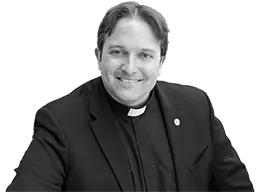
 Fr Matthew Charlesworth SJJesuit PriestSociety of JesusJesuit priest working in Southern AfricaFr. MatthewCharlesworthSJ
 5th Sunday in Ordinary Time
Date: | Season: Ordinary Time before Easter | Year: A
First Reading: Isaiah 58:7–10
Responsorial Psalm: Psalm 12:4–9
| Response: Psalm 12:4a
Second Reading: 1 Corinthians 2:1–5
Gospel Acclamation: John 8:12
Gospel Reading: Matthew 5:13–16
Preached at: the Chapel of Emmaus House in the Archdiocese of Harare, Zimbabwe.
Brothers and sisters,
Today, the Lord calls us to be salt and light through real acts of justice and care, as we see in the Scriptures and in the life of Saint Josephine Bakhita.
Sometimes the biggest problems facing the world do require big, shared solutions. World peace. The threat of nuclear war. Access to clean water and reliable electricity. These are serious problems, and their solutions are not simple, nor can they be achieved by one person alone. But there are also moments when one person can make a difference. In our daily lives, it is often the smaller actions that matter most, and Jesus still calls us to do them. Sharing a meal with someone who would otherwise eat alone. Leaving a light on so someone feels safe walking home. Adding a little salt so food does not spoil. These things seem small, yet without them we quickly notice how harsh the world can become.
Jesus has just spoken the Beatitudes. He has spoken about the poor in spirit, the meek, those who hunger for justice, the merciful, the peacemakers. And before anyone can step back and admire these words, he turns to his followers and says, You are the salt of the earth. You are the light of the world. Not you should be. Not you may become one day. You are. He is not praising them. He is placing responsibility on them.
Salt mattered in the world Jesus lived in. It kept food from spoiling. It slowed decay. It made food worth eating. But salt only works when it is mixed in. You do not notice it when it is doing its job. You notice it when it is missing. Jesus is saying that his followers are meant to live fully inside the world, close enough to its struggles that faith does not stay distant, and clear enough that something good is added. Faith kept on the side, separate and safe, does little good.
Isaiah says much the same thing. He speaks against a religion that looks serious but leaves people suffering. He names the kind of worship God wants. Breaking unfair bonds. Letting the oppressed go free. Sharing food with the hungry. Opening your home to the homeless. Clothing those who lack what they need. Only then, Isaiah says, will light break through. Only then will healing come. Only then will God answer, Here I am.
This kind of faith cannot stay hidden. It affects others. It makes people uncomfortable at times. That is why Jesus speaks about light. A lamp is meant to be put where it can be seen. A city built on a hill cannot be hidden. Light helps people find their way, but it also shows what we might rather ignore.
The psalm today speaks quietly but clearly. It says that the just are a light in the darkness. It says they are not afraid when bad news comes, because their hearts are firm in the Lord. Faith brings courage. Not bravado, not drawing attention, but a steady trust that holds when life becomes hard.
Paul knows this kind of trust. He reminds the Corinthians that when he first came to them, he was not confident or impressive. He felt weak and afraid. He did not rely on clever arguments. He spoke about Jesus Christ and the cross. Like the poor in spirit, he did not hide his limits, and God worked through them. Paul refuses to let weakness become a reason to stay silent. Instead, it becomes the place where God’s work can be seen. Faith, he says, rests on God, not on human ability.
That matters for us. It is easy to say we are not ready, not trained, not strong enough. Paul leaves little room for that. God works through people who are willing to show up.
Today the Church also keeps the International Day of Prayer and Awareness Against Human Trafficking. It is one of the great hidden crimes of our time. People treated as things. Lives controlled through fear and debt. In our own country, girls are lured from their homes with false promises, young men are misled about work, domestic workers suffer in silence. This is not far away. It is part of our world. Isaiah would not let us walk past untouched. Salt that avoids contact cannot slow decay.
This week, the bishops of our country have spoken as our civil leaders prepare to vote on laws that touch the lives of unborn children and their mothers. They ask the nation to pause—not to inflame debate, but to examine our conscience. How do we treat those who cannot yet speak for themselves? What does real care look like when life is hidden, fragile, and easily overlooked? Their appeal is not for outrage or slogans, but for protection, for genuine support for women, and for a shared sense of responsibility. It is a call to be consistent. Having taken the serious step of repealing the death penalty, our country has rightly said that the deliberate taking of human life has no place in our laws. That same commitment now asks to be carried through to the earliest and most vulnerable stages of life. This is Isaiah speaking into our own moment, calling us to let our actions match our beliefs.
Saint Josephine Bakhita knew suffering from the inside. Enslaved as a child, sold many times, marked by pain, she could have closed her heart. Instead, she chose to forgive. She chose to serve. She lived with a freedom that no one could take from her. Her life shows us that suffering does not decide the end of the story.
In a few moments, bread and wine will be taken, blessed, broken, and shared. That pattern is not only for the altar. It is meant to shape us. Taken from ordinary life. Blessed not because we are perfect, but because we offer ourselves. Broken open so that something can be given. Shared for the life of others.
Ignatius would invite us to step into this scene. To notice the darkness. To see the single lamp. To pay attention to what the light shows. And then to hear Jesus say, You are that light. Not finished. Not without faults. But placed where you are.
We are not asked to fix everything. We are asked to do what is ours to do. To let our conscience speak, and not silence it. To pray for those who carry responsibility for laws and policies, and to speak with care when life is at risk, especially the lives of the unborn. To remember that the laws of our country should serve the common good, not only the strong and powerful. To stand close to women and children who are vulnerable, so that faith does not remain words alone. And to trust that God can work even through our limits.
As we pray this morning, let us consider the following questions:
- Where am I keeping my faith separate from daily life?
- Whose darkness am I being asked to enter, not with answers, but by staying present?
- What small, visible act of care or justice can I choose this week so that God’s light reaches someone else?
Source: https://sj.mcharlesworth.fr/homilies/2026-02feb-08-ya-ot-05/
This homily is shared for personal and pastoral use. Please attribute the author and do not alter the meaning when quoting. If you wish this homily to be translated - there is an option on the website which will allow you to translate it into the language of your choice.
Licenced under a Creative Commons Attribution-NonCommercial-NoDerivatives 4.0 International (CC BY-NC-ND 4.0) license.
The author does not speak for the Society of Jesus or for the Catholic Church.
 Receive updates on:
WhatsApp | Telegram | Signal
In preparing this homily, I consulted various resources to deepen my understanding of today’s readings, including using Magisterium AI for assistance. The final content remains the responsibility of the author.