
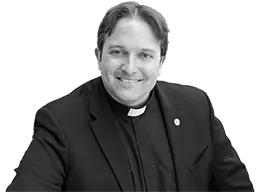
 Fr Matthew Charlesworth SJJesuit PriestSociety of JesusJesuit priest working in Southern AfricaFr. MatthewCharlesworthSJ
 Memorial of St Blaise, bishop and martyr
Date: | Season: Ordinary Time before Easter | Year: A
First Reading: 2 Samuel 18:9–10, 14b, 24–25a, 30–19:3
Responsorial Psalm: Psalm 86:1–6
| Response: Psalm 86:1a
Gospel Acclamation: Matthew 8:17
Gospel Reading: Mark 5:21–43
Preached at: the Chapel of Emmaus House in the Archdiocese of Harare, Zimbabwe.
In our first reading David is standing by the city gate, waiting for news. Everyone else already knows what they want to call this day. The rebellion is over. The danger has passed. It should be a success. David is not thinking about success. He asks one simple question: is my son alive?
When the answer comes, David breaks down. Absalom was not just a rebel or a threat to the throne. He was a son, shaped by a family where wrongs were left untouched and hard conversations never happened. David loved him, but the relationship never healed. By the time the fighting stops, there is nothing left to fix. What looks like victory to the army feels like loss to the father.
Many of us know this experience. Families carry old hurts that were never faced properly. We put off speaking because it feels easier at the time. Sometimes there is still a chance to mend things if someone is willing to speak honestly now. Sometimes there is not. Faith does not pretend otherwise. It teaches us how to live with that pain without becoming hard or resentful.
The psalm today gives words to that place. “Incline your ear, O Lord; answer me, for I am poor and needy.” It is the prayer of someone who knows they cannot sort everything out themselves. David is like that at the gate. Jairus is like that in the Gospel.
In the Gospel, people think they already know how the story ends. Jairus’ daughter is dead. The mourners are in the house. When Jesus says the child is not dead but asleep, they laugh at him. But Jesus turns to Jairus and says, “Do not be afraid; only believe.” Jairus began by asking for help. Now he is asked to keep trusting when things look worse than ever.
On the way to the house, a woman reaches out to touch Jesus. She has been ill for twelve years and is exhausted. She believes that touching him will help, but she is frightened and unsure. Jesus does not let the moment stay unclear. He makes it plain that it is not the cloth that saves her, but her trust.
The Gospel quietly points out something else. The woman has been suffering for twelve years, and the girl who is raised is twelve years old. One life has been worn down slowly. The other seems to end too soon. Jesus brings life to both. No one is outside his concern. No situation is written off.
It is easy to misunderstand faith here. The woman almost treats Jesus like a last option, something to try when everything else has failed. We can do the same. We touch a holy thing, say a prayer, follow a custom, and hope it works. Jesus does not reject that beginning, but he does not leave it there either. He brings her into the open and names what really matters. Trust, not technique. Relationship, not ritual on its own.
Jesus then takes the girl by the hand and tells her to get up. He does not argue with the mourners or try to convince them. Life returns, and he tells the parents to feed her. Trust is shown in what he does, without arguing or explaining himself.
David’s grief, Jairus’ waiting, and the woman’s reaching out have something in common. None of them looks impressive. David does not stand tall in victory. Jairus does not demand an explanation. The woman tries not to be noticed. Yet this is where faith is found. Not in control, not in certainty, but in staying turned towards God when there is nothing left to rely on.
That helps us understand what we do today as we remember St Blaise. We bless throats with candles that were blessed yesterday for Christ, the Light of the nations. This is not magic. The candle does not heal by itself. It is a sign that points us to trust God with something very ordinary and very fragile: our breathing, our speaking, our health. Like the woman in the crowd, we are asked to trust the Lord, not the object.
Both readings warn us against deciding too quickly that something is finished. The army thinks the story is over. The mourners think death has the final word. Faith keeps us from closing the door too soon.
So as we pray this morning, let us ask ourselves:
- Who do I need to speak to while there is still time?
- What broken relationship do I need to place into God’s care, even if it cannot be repaired?
- And where is God asking me to move from habit into real trust?
Source: https://sj.mcharlesworth.fr/homilies/2026-02feb-03-ya-ot-04/
This homily is shared for personal and pastoral use. Please attribute the author and do not alter the meaning when quoting. If you wish this homily to be translated - there is an option on the website which will allow you to translate it into the language of your choice.
Licenced under a Creative Commons Attribution-NonCommercial-NoDerivatives 4.0 International (CC BY-NC-ND 4.0) license.
The author does not speak for the Society of Jesus or for the Catholic Church.
 Receive updates on:
WhatsApp | Telegram | Signal