
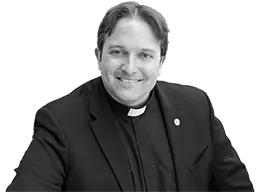
 Fr Matthew Charlesworth SJJesuit PriestSociety of JesusJesuit priest working in Southern AfricaFr. MatthewCharlesworthSJ
 4th Sunday in Ordinary Time
Date: | Season: Ordinary Time before Easter | Year: A
First Reading: Zephaniah 2:3, 3:12–13
Responsorial Psalm: Psalm 146:6–10
| Response: Psalm 5:3
Second Reading: 1 Corinthians 1:26–31
Gospel Acclamation: Matthew 5:12a
Gospel Reading: Matthew 5:1–12a
Preached at: the Chapel of Emmaus House in the Archdiocese of Harare, Zimbabwe.
Jesus goes up a hill and sits down. He does not tower over the crowd. He settles himself and waits, and they gather around him. Some of you may remember the scene from The Chosen. People arrive carrying different burdens. Some are curious. Some are tired. Some are already aching for words they cannot yet name. Jesus looks at them, not as a mass, but as persons. And then he speaks.
He does not begin with threats or conditions. He does not start by saying what must be avoided. He begins by naming who is already close to the Kingdom.
Happy are the poor in spirit.
Jesus is not blessing deprivation. He is speaking about people who know, from experience, that life is not something they can manage on their own terms. The poor in spirit are those who have learned that strength can fail, plans can unravel, and control is often an illusion. They stand before God without pretence. Jesus says the Kingdom already belongs to them.
This is not a new idea. The prophet Zephaniah spoke to a people who had trusted wealth, power, and false assurances, and who had watched those things collapse. He does not call the influential to save the nation. He turns to the humble, the anawim. Seek the Lord, he says. Seek justice. Seek humility. God would preserve a remnant, not defined by status, but by faithfulness. They would endure because they placed their security in the Lord, not in idols.
The psalm makes clear why this is so. It tells us what God is like. God keeps faith. God lifts those bent low. God acts where dignity is at risk. God does not admire strength for its own sake. God stands where life is exposed. If we want to know where God is at work, we look where human worth is being defended.
Paul sees this same pattern in Corinth. The community admired clever speech and social standing. They were tempted to measure the Gospel by the standards of the city. Paul refuses that logic. Not many of you were wise by those standards, he says. Not many were powerful. And yet God chose you. Not by accident. God chose you so that the world’s way of measuring success would be exposed for what it is. Salvation comes through a crucified man, not through human brilliance.
We can recognise this pattern in our own lives. In Zimbabwe, many live with pressure that wears people down. Work is uncertain. Costs rise. Corruption tempts even those who want to live honestly. Young people leave because hope feels thin. In such conditions, the temptation is to believe that survival requires compromise or hardness. The Scriptures today say otherwise. God works through those who remain faithful in small ways, through honesty that does not yield to the lure of corruption, through patience that refuses to become cruel.
When Jesus speaks the Beatitudes, he is not giving a new set of spiritual targets. He is telling the truth about how God works. The readings today are not saying different things. They are tracing the same pattern.
Zephaniah looks at a society that has trusted power, wealth, and false promises, and he asks a simple question. Who will remain when those things fail. His answer is not the strong or the secure. God preserves the humble. Those who seek justice. Those who speak without deceit. A remnant, small enough to be missed, yet faithful enough to endure.
The psalm then shows us the God who stays with such people. God keeps faith. God lifts those bent low. God acts where life is under pressure. God does not wait for people to become impressive. God moves toward those who are vulnerable.
Paul sees this pattern written into the life of the Church itself. When he looks at the community in Corinth, he does not flatter them. Not many of you were wise by human standards, he says. Not many were powerful. And yet God chose you. Not by accident. God chose you so that boasting would fall silent.
That is the ground Jesus is standing on when he sits on the hill and begins to speak.
So when he says, happy are the poor in spirit, he is not praising insecurity or weakness. He is recognising those who live without illusions about themselves. They know that life cannot be controlled. They know that everything is received. Jesus says the Kingdom is already their home.
When Jesus blesses those who mourn, he is not offering a quick answer to suffering. He is naming those who refuse to turn away from what is broken. Mourning keeps the heart open. It resists the temptation to grow hard or indifferent. Such people are able to recognise God’s faithfulness, not as an escape, but as a presence that does not abandon them.
When Jesus calls the meek blessed, he is not describing people who have given up. He is describing strength shaped by restraint. Power that does not humiliate. These are the people God can trust with responsibility, because their strength is guided by care.
When Jesus speaks of hunger and thirst for righteousness, he echoes Zephaniah’s call to seek justice and the psalm’s assurance that God acts for the oppressed. This hunger is not restless anger. It is a refusal to accept injustice as normal. It keeps hope alive even when change is slow.
When Jesus blesses the merciful, the clean of heart, the peacemakers, he is describing a community learning a different way to live together. A people who refuse deceit. Who refuse rivalry. Who refuse violence as their first response. This is the kind of community Paul longed to see take root in Corinth.
And when Jesus blesses those who are persecuted for doing what is right, he is more precise still. He speaks of those who suffer because they belong to him. Because they bear his name. Because they choose his way when another path would be safer. Faithfulness to Jesus sometimes brings loss, misunderstanding, or exclusion. But such people are not outside the Kingdom. They are closest to its heart.
Taken together, the Beatitudes do not describe exceptional individuals. They describe a people. The remnant Zephaniah trusted would endure. The community Paul struggled to shape. The Kingdom Jesus reveals, already present, already at work.
For those shaped by Ignatian prayer, this Gospel invites us to notice what is moving within us. Not to judge ourselves, but to pay attention. Where God is drawing us. Where we resist. Where we are being invited to trust more deeply. The Beatitudes become a way of seeing our lives truthfully, in God’s light. Over time, they form habits of heart. They shape the kind of people we are becoming.
The Church will not be credible because it is loud or influential. It will be credible because it remains close to those who struggle, because it speaks truth without fear, because it chooses mercy when hardness would be easier. This is how God has always worked.
Jesus sits on the hill and says, happy are you. He is not describing an easy life. He is revealing a way that remains true when life is stripped back to what matters. Here at this altar, we join the remnant, receiving the Bread that strengthens meekness and mercy for the week ahead. As Jesus sat among them then, so he nourishes us here, not from a distance, but from within our shared life.
As we pray now, three questions may stay with us.
- Where am I clinging to control, and what would it mean to place that part of my life more honestly before God?
- Where do I turn away from suffering, and how am I being asked to remain present rather than detached?
- In one concrete situation this week, how can I choose mercy or work for peace, even if it costs me?
Lord, shape our hearts to walk your way. Amen.
Source: https://sj.mcharlesworth.fr/homilies/2026-02feb-01-ya-ot-04/
This homily is shared for personal and pastoral use. Please attribute the author and do not alter the meaning when quoting. If you wish this homily to be translated - there is an option on the website which will allow you to translate it into the language of your choice.
Licenced under a Creative Commons Attribution-NonCommercial-NoDerivatives 4.0 International (CC BY-NC-ND 4.0) license.
The author does not speak for the Society of Jesus or for the Catholic Church.
 Receive updates on:
WhatsApp | Telegram | Signal
In preparing this homily, I consulted various resources to deepen my understanding of today’s readings, including using Magisterium AI for assistance. The final content remains the responsibility of the author.