
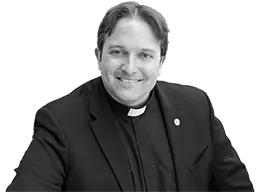
 Fr Matthew Charlesworth SJJesuit PriestSociety of JesusJesuit priest working in Southern AfricaFr. MatthewCharlesworthSJ
 Feast of the Baptism of the Lord
Date: | Season: Christmas | Year: A
First Reading: Isaiah 42:1–4, 6–7
Responsorial Psalm: Psalm 29:1–4, 9–10
| Response: Psalm 29:11b
Second Reading: Acts 10:34–38
Gospel Acclamation: Mark 9:7
Gospel Reading: Matthew 3:13–17
Preached at: the Chapel of Emerald Hill Children’s Home in the Archdiocese of Harare, Zimbabwe.
This morning, let us reflect on our baptism as the beginning of our life with Christ, the source of our mission, and the foundation for how we serve others in the Church and the world.
Dear brothers and sisters in Christ, dear friends.
Today the Church invites us to think again about something very simple and very important: our baptism is not just something that happened once. It shapes who we are and how we live, every day of our lives.
In the first reading from Isaiah, God speaks about a servant whom he has chosen and whom he supports. This servant is not loud or harsh. He does not break what is already weak. He brings justice with patience and care. This tells us something important about how God works. God chooses people not to dominate others, but to protect them. In God’s eyes, leadership always looks like service.
The psalm today speaks about the voice of the Lord over the waters. It uses the image of storms and thunder to remind us that God is strong. But the psalm does not end with fear. It ends with a promise: “The Lord blesses his people with peace.” God’s strength is not meant to frighten us, but to protect us.
When we hear of war in Gaza, Ukraine, and Sudan, and of unrest and injustice in places like Iran and Venezuela, we are reminded that violence is not the only way people hurt. Fear, instability, and oppression also wound deeply. Children lie awake at night. Families live without security. God knows this suffering. And the same God whose voice stills the storm continues to speak peace into our hearts — and calls us to become instruments of that peace.
God’s peace does not mean that all problems disappear. It means that God stays close to us in the middle of them. For those who are tired, worried, or grieving, this is very good news. God’s peace is stronger than violence and hatred, and it calls us to live differently.
In the Gospel from Matthew, Jesus steps into the Jordan River to be baptised. John the Baptist does not understand why Jesus would do this. Jesus has no sin. Yet Jesus chooses to stand where everyone else is standing. He steps into the water with ordinary people. When he comes out of the river, the Spirit comes upon him and the Father says, “This is my Son, the Beloved.” Jesus begins his mission not with power, but with love. And these words are spoken to each of us today as well. God delights in each one of us.
In the Acts of the Apostles, Peter tells us that God shows no partiality. That means God’s love is not limited by background, tribe, age, or status. This matters deeply in a place like Zimbabwe, where some struggle more than others, where some feel forgotten, and where some carry heavy burdens. Baptism tells us that everyone belongs. We are all God’s beloved children.
The Church today is helping us understand baptism more clearly. We are learning again that mission and responsibility in the Church come from baptism, not only from ordination. This is why Pope Leo XIV, and Pope Francis before him, have asked lay people, including women, to take on real leadership roles in the Church. They are not doing this to follow trends, but because baptism already gives a share in Christ’s mission. We are called to continue this inclusive example in our own parishes, schools, and Church communities. Baptism makes us part of Christ’s work in the world, and all of us are invited to take part in that work, using the gifts God has given us.
This is good news for everyone here. It means a child can live their baptism by being kind at school, helping a friend who is sad, or praying for children in places where there is war. It means parents live their baptism by loving faithfully and teaching what is right. It means older people live their baptism by offering wisdom, prayer, and forgiveness.
And it also speaks in a special way to those whose family stories have been marked by loss or change. In the Church, no one stands alone; we become a family for one another.
So now, let us listen quietly in our hearts.
To every child who has lost parents,
to every orphan,
to every heart that aches for family,
the Father whispers today, “You are my beloved son. You are my beloved daughter.”
In baptism, God does not abandon anyone.
In baptism, God claims you as his own.
In baptism, the Spirit strengthens you and places you in the care of Christ and his Church.
You are not forgotten. You are not broken. You belong.
Our world shows us what happens when leadership forgets this truth. People suffer. Violence grows. Baptism calls us to a different way. It teaches us to serve, to protect the weak, and to work for peace, even in small and quiet ways.
So today, let us remember: baptism is not only about washing away sin. It is about receiving a mission. It is about being loved first, and then being sent.
As we prepare to continue with the Mass, I invite you to reflect on these questions:
- How can I live my baptism more clearly in my daily life?
- Who around me needs kindness, peace, or care this week?
- How can I serve others, even in small ways, as Jesus does?
Let us now pause in silence to hear God’s voice calling each of us by name, and to hear in our hearts that we are loved by the Father. And having heard, let us once again say yes to whatever God is asking of us in our lives. Amen.
Source: https://sj.mcharlesworth.fr/homilies/2026-01jan-11-ya-ct-04/
This homily is shared for personal and pastoral use. Please attribute the author and do not alter the meaning when quoting. If you wish this homily to be translated - there is an option on the website which will allow you to translate it into the language of your choice.
Licenced under a Creative Commons Attribution-NonCommercial-NoDerivatives 4.0 International (CC BY-NC-ND 4.0) license.
The author does not speak for the Society of Jesus or for the Catholic Church.





In preparing this homily, I consulted various resources to deepen my understanding of today’s readings, including using Magisterium AI for assistance. The final content remains the responsibility of the author.