
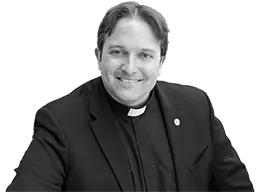
 Fr Matthew Charlesworth SJJesuit PriestSociety of JesusJesuit priest working in Southern AfricaFr. MatthewCharlesworthSJ
 Memorial of Sts Basil the Great and Gregory Nazianzen, bishops and doctors of the Church
Date: | Season: Christmas | Year: A
First Reading: 1 John 2:22–28
Responsorial Psalm: Psalm 98:1–4
| Response: Psalm 98:3cd
Gospel Acclamation: Hebrews 1:1–2
Gospel Reading: John 1:19–28
Preached at: the Chapel of Emmaus House in the Archdiocese of Harare, Zimbabwe.
The readings this morning are about recognising who Christ is, who we are not, and learning to remain with him now that he has come close.
Dear brothers and sisters in Christ, dear friends, Christmas keeps asking us a simple but demanding question. Not “what happened?”, but “who are you?”. It is the question that opens today’s Gospel, and it is the question that quietly follows us through these days after the feast.
Our first reading from the First Letter of John comes from a community under pressure. People are unsettled. Confident voices are offering clever explanations and new insights. John does not argue at length. He names the centre. Whoever denies that Jesus is the Christ has lost hold of the truth. Faith, for John, is not about having the most advanced ideas. It is about remaining. You have been anointed, he says, and that anointing remains in you.
That word “remain” is practical. It means staying faithful to the relationship that began when Christ first became real to us. John is not dismissing learning or teaching. He is warning against a faith that lives only in the head. Knowing the Scriptures is not enough if the Word has not shaped our choices, our speech, and our relationships. Anything that cuts us off from love is not light, no matter how impressive it sounds. Christmas faith is not proved by knowledge alone, but by a life slowly conformed to Christ.
The psalm speaks of salvation made visible in the sight of the nations. God’s saving work is meant to be seen. In Zimbabwe in 2026, where many live with daily uncertainty about work, food, and stability, this visibility matters. If God has drawn close to human life, then human dignity must be defended in real ways. How we speak about the poor, how we treat workers and students, how patient we are with one another, all of this becomes part of our Christmas witness. Joy that cannot be seen in mercy remains incomplete.
The Gospel Acclamation from the Letter to the Hebrews gives us the heart of the season’s theme. God has spoken through a Son. Not a theory, not a system, but a person who shares our life. And this closeness has a direction. The light that shines from the manger always leads us forward, from manger to cross and on to the empty tomb. To remain in the Incarnate Word is to be drawn into his whole saving work.
That helps us hear the Gospel from John more clearly. The priests and Levites keep asking John the Baptist the same question. Who are you? Who do you think you are? John answers by saying who he is not. I am not the Messiah. I am not Elijah. I am not the Prophet. Only then does he say who he is. I am a voice.
In a complex world, many are eager to offer us ready-made identities. John shows another way. His identity is not built on status but on service. He is a voice pointing to what God is doing now. And then he says the line that belongs at the heart of Christmas. Among you stands one whom you do not know. Christ is already present, but presence does not guarantee recognition. We try to pin him down, to claim him for our group or our agenda, but he resists being reduced. Jesus cannot be owned or reshaped. He can only be received.
When John says he is not worthy to untie the strap of Christ’s sandal, he is saying more than “I am humble”. In the Scriptures, removing a sandal could mean claiming what belonged to another. John refuses that right. He will not take the place of the bridegroom. Christ alone stands at the centre. John’s joy is to point away from himself.
This is also our calling. We are not the light. We are meant to help others see it. We are voices, not the Word.
This clarity was defended with care and courage by today’s saints, Basil the Great and Gregory Nazianzen. At a time of confusion about who Christ truly is, they protected the truth of the Incarnation. Basil insisted that if Christ truly took on human flesh, then the poor and the sick could never be ignored. Gregory taught that what Christ did not assume could not be healed. Their defence of truth was never abstract. It protected real lives and real hope.
As people shaped by Ignatian prayer, we are invited to attentiveness. In prayer this week, place yourself by the Jordan. Hear the questions. Watch John refuse false importance. Notice Christ already present. Then come to the altar. Just as John pointed beyond himself, so the Eucharist makes Christ stand among us today. Under bread and wine, his coming among us becomes present again, inviting us into a communion that changes how we live.
Christmas does not rush us. It asks us to remain.
So I leave you with three questions to pray with this morning.
- Who am I allowing the world to tell me I am, and where is Christ asking me to let go of that identity?
- Where might Christ already be standing among us, unnoticed, waiting to be recognised and received?
- What concrete change this week will show that I am not only hearing the Word, but allowing it to shape my life?
Source: https://sj.mcharlesworth.fr/homilies/2026-01jan-02-ya-ct-02/
This homily is shared for personal and pastoral use. Please attribute the author and do not alter the meaning when quoting. If you wish this homily to be translated - there is an option on the website which will allow you to translate it into the language of your choice.
Licenced under a Creative Commons Attribution-NonCommercial-NoDerivatives 4.0 International (CC BY-NC-ND 4.0) license.
The author does not speak for the Society of Jesus or for the Catholic Church.



In preparing this homily, I consulted various resources to deepen my understanding of today’s readings, including using Magisterium AI for assistance. The final content remains the responsibility of the author.