
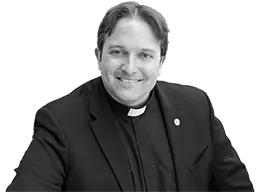
 Fr Matthew Charlesworth SJJesuit PriestSociety of JesusJesuit priest working in Southern AfricaFr. MatthewCharlesworthSJ
 Feast of St John, Apostle and Evangelist
Date: | Season: Christmas | Year: A
First Reading: 1 John 1:1–4
Responsorial Psalm: Psalm 97:1–2, 5–6, 11–12
| Response: Psalm 97:12
Gospel Acclamation: We praise you, O God, we acknowledge you to be the Lord. The glorious company of the apostles praise you, O Lord.
Gospel Reading: John 20:1a, 2–8
Preached at: the Chapel of Emmaus House in the Archdiocese of Harare, Zimbabwe.
This homily is about how love shapes the way we see, and how learning to see rightly changes how we live.
Dear brothers and sisters in Christ, dear friends, these days of Christmas move quickly. One feast follows another, and before we have settled into the joy of the manger, the Church places before us the whole sweep of Jesus’ life. Birth, death, and now resurrection, all held close together. It is not meant to rush us, but to teach us how to see the meaning of it all.
On this feast of Saint John the Apostle, we meet a man who learned faith not first through argument, but through closeness. John does not begin with ideas. He begins with experience.
Our first reading, from the First Letter of John, chapter 1, verses 1 to 4, is almost stubborn in its simplicity. What we have heard. What we have seen. What we have touched. John piles up these words because he knows how easily faith can drift into something vague. In the Jewish world of his time, truth was confirmed by witnesses, by people who could say, I was there. John speaks as one who stayed. He stayed with Jesus long enough for faith to become personal.
This matters for us. Many people today are tired of big words. In Zimbabwe in 2025, people know too well what it is like to hear promises that never take flesh. Young adults struggle to find work. Families stretch small incomes across long months. In such a place, faith cannot survive as talk alone. John reminds us that joy becomes real when faith is lived in concrete ways, when people feel seen, heard, and accompanied.
The psalm we pray, Psalm 97, verses 1 to 2, 5 to 6, and 11 to 12, holds together two things that often feel opposed. The Lord reigns, and yet clouds and darkness surround him. The psalmist is honest. God’s rule does not remove all confusion. In the Scriptures, clouds often signal God’s presence, not his absence. God is close, even when things are unclear. Light, the psalm says, is sown for the just. It grows quietly, over time.
That image fits well with Advent, which has not yet left us behind. Advent trained us to wait without panic, to trust that God is at work even when results are slow. That kind of patience is not passive. It is steady. It keeps doing what is right, even when the outcome is hidden.
Then the Gospel brings us to the early morning of Easter, from John chapter 20, verses 1 to 8. It is still dark. Mary Magdalene runs. Peter runs. The other disciple, the one Jesus loved, runs too, and arrives first. Yet he waits. That small detail tells us something important. Love does not need to push its way forward. It knows when to pause.
Inside the tomb, nothing dramatic happens. No angels speak. No risen Jesus appears. There are only signs: the cloths lying there, and the face cloth folded and set apart. John notices. Grave robbers do not stop to tidy. More than that, John remembers Lazarus. When Lazarus came out of the tomb, he was still bound in his wrappings, still caught between life and death. This tomb tells a different story. Death has not been delayed. It has been undone.
At his birth, Jesus was wrapped in cloths and laid in a borrowed manger. At his death, he was wrapped again and laid in a borrowed tomb. John has seen these cloths before. Love helps him remember. And remembering helps him see. From beginning to end, God chooses closeness, not control; dependence, not power.
The Gospel says simply, he saw and he believed. John believes without seeing Jesus. Why him, and not Peter? Why not Mary? The Gospel gives us a clue. John is the one who leaned close to Jesus at the last supper. In the ancient world, that closeness was a sign of trust. John had learned Jesus’ heart over time. Love had trained his eyes.
This is important for our own faith. Belief is not about being quicker or smarter than others. It grows through relationship. Through staying close. Through paying attention. Ignatius of Loyola understood this well. In prayer, he invites us not just to think about a scene, but to enter it. To stand where John stood. To look at what he looked at. To notice what stirs in us.
If we do that with today’s Gospel, we may notice where our own eyes hesitate. Perhaps we see emptiness where we hoped for certainty. Perhaps we struggle to trust that God is at work when the signs are small. John teaches us that faith often begins quietly, with noticing, with remembering, with letting love interpret what we see.
And this kind of seeing has consequences. If Christ is risen, then no life is without value. If love is stronger than death, then systems that crush the poor, silence the young, or forget the sick cannot be accepted as normal. In our own communities, when people are left waiting without hope, the empty tomb challenges us. It asks whether we are living as people who truly believe that new life is possible.
John does not shout this message. He lives it. He stays near the cross. He waits at the tomb. He believes before everything makes sense. And then he spends his life telling the Church, simply and clearly, that God is love.
As we continue through Christmas, John invites us to a quieter but deeper faith. A faith shaped by closeness. A faith that sees carefully. A faith that acts with patience and courage.
So let us take a moment, in the spirit of Ignatius, and ask ourselves:
- Where this week am I being asked to slow down and really notice what God is doing?
- Who around me needs not answers, but presence that listens and stays?
- And what small, faithful step can I take now to live as someone who believes that life, not death, has the final word?
Source: https://sj.mcharlesworth.fr/homilies/2025-12dec-27-ya-ct-01/
This homily is shared for personal and pastoral use. Please attribute the author and do not alter the meaning when quoting. If you wish this homily to be translated - there is an option on the website which will allow you to translate it into the language of your choice.
Licenced under a Creative Commons Attribution-NonCommercial-NoDerivatives 4.0 International (CC BY-NC-ND 4.0) license.
The author does not speak for the Society of Jesus or for the Catholic Church.



In preparing this homily, I consulted various resources to deepen my understanding of today’s readings, including using Magisterium AI for assistance. The final content remains the responsibility of the author.