
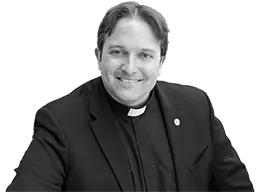
 Fr Matthew Charlesworth SJJesuit PriestSociety of JesusJesuit priest working in Southern AfricaFr. MatthewCharlesworthSJ
 Feast of St Stephen, First Martyr
Date: | Season: Christmas | Year: A
First Reading: Acts 6:8–10, 7:54–59
Responsorial Psalm: Psalm 31:3c–4, 6, 8ab, 16bc, 17
| Response: Psalm 31:6
Gospel Acclamation: Psalm 118:26a, 27a
Gospel Reading: Matthew 10:17–22
Preached at: the Chapel of Emmaus House in the Archdiocese of Harare, Zimbabwe.
Dear brothers and sisters in Christ, the child born in the light of Christmas is followed at once by a man who dies in that same light, refusing to let it be extinguished.
We would happily linger at the manger. We would keep the night soft, the light gentle, the world hushed around a child. But the Church moves us on. On this second day of Christmas, we are led straight from straw to stones, from cradle to courtroom. We meet Saint Stephen, the first to show us what Christmas looks like when it is taken seriously.
There is an old Christian instinct behind today’s feast. Yesterday we celebrated Christ’s birth into the world. Today we celebrate Stephen’s birth into heaven. The Church even remembers that on this very date, centuries later, Stephen’s resting place was revealed, and when his relics were lifted from the earth, the sick were lifted from their suffering. Augustine would later tell of healings that followed wherever Stephen was welcomed. The stones that killed him did not end his life. They released it. His witness did not end with his death. It began to spread.
Luke places Stephen before the council in our first reading from the Acts of the Apostles. He is introduced first not as a preacher, but as a servant, chosen to care for the neglected and to hold the Church together in charity. He is accused falsely, just as Jesus was. But Stephen does not offer a narrow defence. He tells a long story. He walks patiently through Abraham, Joseph, Moses, and the prophets, showing how God was never confined to one place or controlled by one group. God spoke in deserts, in foreign lands, in tents and prisons. The Temple was a gift, not a cage. This is what enrages them. Stephen is not attacking God. He is freeing God from their fear.
Then comes the vision. Stephen sees the heavens opened and the Son of Man standing at the right hand of God. Standing. Christ rises, not to condemn the council, but to receive his witness. As Jesus once entrusted his spirit to the Father, Stephen entrusts his spirit to Jesus. The faith born in Bethlehem now speaks with adult clarity. The child is confessed as Lord.
Luke adds a quiet detail that matters. The witnesses lay their cloaks at the feet of a young man named Saul. Luke lingers over the detail. In Israel’s memory, cloaks are mantles. When Elijah fell, Elisha lifted his cloak and carried his spirit forward. So too here. Saul will one day lift Stephen’s words into the world. The fire that burns in Stephen’s final prayer will blaze across cities and seas through Paul. Grace does not hurry. Sometimes it waits, folded at our feet.
The psalm today gives us the prayer that holds Stephen together. “Into your hands I commend my spirit.” It is the prayer spoken when all other ground has given way. God’s hands become both shelter and direction. Stephen does not escape death, but he is no longer afraid.
The Gospel from Matthew sharpens the picture. Jesus tells his disciples they will be handed over, misunderstood, resisted. But he also tells them not to rehearse their defence. Faith is not cleverness under pressure. It is trust under fire. The Spirit will speak. Stephen endures to the end, and in him we see that endurance is not grim survival, but faithful trust carried through to glory.
This speaks close to home. In Zimbabwe, and across our region, many carry silent stones. Young people with education but no work. Families stretched thin by rising costs. The poor pushed to the edges while power protects itself. Stephen does not teach us to seek conflict, but he refuses us the comfort of silence. He shows us how to speak without hatred, how to forgive without pretending that injustice is small.
For those shaped by Ignatian prayer, by learning to pray with the scene before us, today invites us into the dust and the noise. Imagine the dust, the noise, the tightening circle. Notice where Christ is. Standing. Watching. Receiving. In your examen this week, notice where fear closes you in and where truth asks you to step forward. Stephen’s courage was not sudden. It was practised in prayer.
The Church places Stephen beside the manger so that we do not mistake Christmas for decoration. The Word became flesh, and flesh that loves truth will sometimes be bruised. Yet the heavens are open. Christ is standing. Nothing given to God in truth is ever lost.
As we go into this day, let us carry three questions in prayer.
- Where am I being asked to speak or act truthfully, even if it costs me comfort?
- Whom am I called to forgive so that my heart does not harden?
- And when fear rises, can I place my life again into the hands of the Lord and trust that those hands are steady enough to hold me?
Source: https://sj.mcharlesworth.fr/homilies/2025-12dec-26-ya-ct-01/
This homily is shared for personal and pastoral use. Please attribute the author and do not alter the meaning when quoting. If you wish this homily to be translated - there is an option on the website which will allow you to translate it into the language of your choice.
Licenced under a Creative Commons Attribution-NonCommercial-NoDerivatives 4.0 International (CC BY-NC-ND 4.0) license.
The author does not speak for the Society of Jesus or for the Catholic Church.





In preparing this homily, I consulted various resources to deepen my understanding of today’s readings, including using Magisterium AI for assistance. The final content remains the responsibility of the author.