
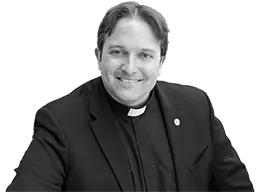
 Fr Matthew Charlesworth SJJesuit PriestSociety of JesusJesuit priest working in Southern AfricaFr. MatthewCharlesworthSJ
 24th December
Date: | Season: Advent | Year: A
First Reading: 2 Samuel 7:1–5, 8b–12, 14a, 16
Responsorial Psalm: Psalm 89:2–5, 27, 29
| Response: Psalm 89:2
Gospel Reading: Luke 1:67–79
Preached at: the Chapel of Emmaus House in the Archdiocese of Harare, Zimbabwe.
Dear brothers and sisters in Christ, today’s Scriptures tell us that God does not move into the houses we build for him; God builds a home in us, and then walks with us into the night, lighting the road as we go. This is the promise that runs through the whole of Advent.
Our first reading comes from the Second Book of Samuel. King David has settled. The wars have eased. The palace walls are strong. And in that calm moment, David feels a holy discomfort. He lives comfortably in cedar while the ark of God rests in a tent. It feels wrong. So he plans to build a house for God. Yet the prophet Nathan brings a surprise. God has never asked for a house. God reminds David that it was not David who carried God, but God who carried David. From pasture to palace, from anonymity to anointing, God has been the builder all along.
In the ancient world, temples were signs of control. To house a god was, in some sense, to contain him. But Israel’s God refuses confinement. Instead, God makes a promise. Not a building of stone, but a house of people. A line. A future. A kingdom that will stand even when bricks fall. Rabbinic tradition hears in this passage a deep reversal. David wants to act. God chooses to give. Grace comes before achievement. Promise before performance. It is a word many of us need to hear in a culture that prizes output, success, and visible results, even in our churches.
The psalm today, Psalm 89, picks up that promise and sings it into memory. “I will sing forever of your mercies, O Lord.” The Hebrew word for mercy here is hesed. It means loyal love, steadfast kindness, love that does not walk away when circumstances change. The psalmist ties God’s mercy to God’s faithfulness. What God has promised, God will not forget. In a land like ours, where many promises have been broken and where young people in Zimbabwe wonder if tomorrow will be kinder than today, this is not mere poetry. It is sustenance. It is bread for the journey.
Then we arrive at the Gospel from Luke. Zechariah speaks at last. His tongue, once tied by fear and doubt, is loosened by wonder. What pours out is the Benedictus, a song that looks backwards and forwards at the same time. God has visited his people. God has raised up salvation. God has remembered the covenant sworn to Abraham. Notice the verbs. Visited. Raised. Remembered. This is not a distant God. This is a God who steps into history, into flesh, into family.
Luke places this song before the birth of Jesus, as if to remind us that hope often arrives before it can be seen. Zechariah sings of freedom from fear, of light for those who sit in darkness and in the shadow of death. For a people living under occupation, this was not poetry. Darkness meant soldiers in the streets, taxes taken by force, land controlled by others, lives lived under watch.
Today, darkness may look like war that grinds on in Ukraine, violence that refuses to loosen its grip on the Holy Land, and children who learn the sound of sirens before they learn peace. It may also look like unemployment, rising prices, migration that breaks families apart, clinics without medicine, classrooms stretched beyond hope. Yet the promise is unchanged. A dawn is coming—not from weapons or negotiations, not from the palaces of power, but from the tender mercy of God, who enters history quietly and refuses to abandon those who wait in the dark.
Ignatius would ask us not just to hear this, but to enter it. Imagine the scene. The small crowd. The child in Zechariah’s arms. The sharp intake of breath as the old priest finds his voice. Where are you standing? What do you feel as the words fall into the air? Consolation often comes like this, quietly, through ordinary people who dare to trust again.
There is also a gentle challenge here. God builds a house through people who make room. David had to let go of his plans. Zechariah had to learn silence before he could speak truth. Advent asks us where we need to loosen our grip. In a society marked by sharp inequality, this means asking how our choices make space for others. It means noticing who is left waiting in the tent while others live in cedar. It means allowing God’s promise to shape how we vote, spend, welcome, and forgive.
As we stand on the threshold of Christmas, the Scriptures do not rush us. They steady us. God is faithful. God is near. God is at work, even when the night feels long. The house God is building is still rising, one act of mercy at a time, often unseen, one life opened to light.
So as we prepare our hearts for the coming days, I leave you with three questions to carry into prayer this week.
- Where have I been trying to build something for God, when God may be asking to build something in me?
- What darkness, personal or shared, do I need to let the light of Christ touch without fear?
- And finally, whose tent is God asking me to notice, to enter, and to honour, so that his promise may find a home among us today?
Source: https://sj.mcharlesworth.fr/homilies/2025-12dec-24-ya-at-04/
This homily is shared for personal and pastoral use. Please attribute the author and do not alter the meaning when quoting. If you wish this homily to be translated - there is an option on the website which will allow you to translate it into the language of your choice.
Licenced under a Creative Commons Attribution-NonCommercial-NoDerivatives 4.0 International (CC BY-NC-ND 4.0) license.
The author does not speak for the Society of Jesus or for the Catholic Church.





In preparing this homily, I consulted various resources to deepen my understanding of today’s readings, including using Magisterium AI for assistance. The final content remains the responsibility of the author.