
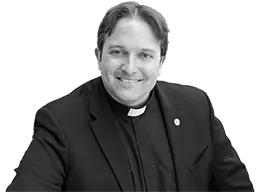
 Fr Matthew Charlesworth SJJesuit PriestSociety of JesusJesuit priest working in Southern AfricaFr. MatthewCharlesworthSJ
 22nd December
Date: | Season: Advent | Year: A
First Reading: 1 Samuel 1:24–28
Responsorial Psalm: 1 Samuel 2:2, 4–8ab
| Response: 1 Samuel 2:1a
Gospel Reading: Luke 1:46–56
Preached at: the Chapel of Emmaus House in the Archdiocese of Harare, Zimbabwe.
Dear brothers and sisters in Christ, as Advent comes close to its end, the Church asks us to listen to three songs. They come from Hannah, from Israel, and from Mary. They rise from lives that knew waiting, worry, and weakness. They remind us that when God draws near, even long silence can learn how to sing.
Our first reading comes from the First Book of Samuel. Hannah brings her young son Samuel to the shrine at Shiloh. For years she had prayed for a child. Her prayer was not prepared or public. It was raw and private, poured out in tears. Her name, Hannah, means grace. She knew that this child was not a reward to keep but a gift to return. In that world of that time, a son meant safety for old age and honour for the family. To hand him over was costly. Hannah teaches us that faith is not only about asking God for help, but about trusting God enough to let go, sometimes letting go of that which is most precious to us.
Her prayer continues in the psalm we hear today, also from First Samuel. She speaks of a God who turns things upside down. The strong are brought low. The weak are lifted up. The hungry are fed. The rich are sent away empty. This is not just poetry. It is a clear picture of how God works. God is not distant or neutral. God pays attention to those pushed aside. In Zimbabwe today, where many struggle with daily costs, with poor services, and with tired hearts, Hannah’s words still ring true. They tell us that God sees the poor and does not forget them.
The Gospel takes us to Luke. Mary’s Magnificat echoes Hannah’s song almost line by line. Mary speaks not only for herself, but for her people. What God has done for her, God wants to do for the world. Mary’s joy is strong, but it is not naïve. She is young, unmarried, and vulnerable. She knows that her future is uncertain. Yet she praises God. This is the heart of the faith we return to during Advent. Not pretending that life is easy, but trusting that God is faithful.
Mary calls God her Saviour. She praises a God who lifts up the lowly and fills the hungry. Luke’s Gospel returns to this theme again and again. Jesus will later speak the same truth in the Beatitudes. God’s concern is not only for the soul, but for the whole person. Hunger of the body matters. Dignity matters. In a country where students worry about jobs, where families stretch every dollar, Mary’s song asks us a quiet but firm question. If this is how God acts, how should we live?
Ignatius invites us to pray with our imagination. We can fruitfully picture Mary speaking these words. We can hear her steady voice. She does not know, at this stage, how everything will turn out. But still, she trusts. Ask yourself where God may be asking you to trust without having full control. Ask where fear has kept you silent when God is inviting you to speak or to act.
These readings share one clear message. God lifts up, God feeds daily, God remembers always. And God often works through ordinary people who say yes. When we notice those who are struggling, when we share what we have, when we refuse to look away, God’s work continues through us. Advent reminds us that waiting is not passive. It is an active hope.
As Christmas draws nearer, the Church gives us a song before she gives us a child. Because before God is born into the world, God wants to be born again in our hearts. The prayers of Hannah, Mary, and Israel show us that praise can rise even when life is uncertain, and that God is closest to those who feel small.
I leave you with three questions for prayer this week.
- Where have I seen God at work in my life, and how am I being asked to respond?
- Who around me is struggling, and what simple, real action can I take?
- What fear do I need to place in God’s hands as I prepare for Christmas?
Source: https://sj.mcharlesworth.fr/homilies/2025-12dec-22-ya-at-04/
This homily is shared for personal and pastoral use. Please attribute the author and do not alter the meaning when quoting. If you wish this homily to be translated - there is an option on the website which will allow you to translate it into the language of your choice.
Licenced under a Creative Commons Attribution-NonCommercial-NoDerivatives 4.0 International (CC BY-NC-ND 4.0) license.
The author does not speak for the Society of Jesus or for the Catholic Church.





In preparing this homily, I consulted various resources to deepen my understanding of today’s readings, including using Magisterium AI for assistance. The final content remains the responsibility of the author.