
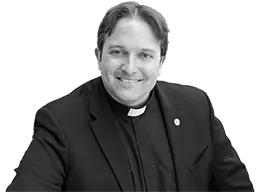
 Fr Matthew Charlesworth SJJesuit PriestSociety of JesusJesuit priest working in Southern AfricaFr. MatthewCharlesworthSJ
 4th Sunday of Advent
Date: | Season: Advent | Year: A
First Reading: Isaiah 7:10–14
Responsorial Psalm: Psalm 24:1–6
| Response: Psalm 24:7c, 10b
Second Reading: Romans 1:1–7
Gospel Acclamation: Matthew 1:23
Gospel Reading: Matthew 1:18–24
Preached at: the Chapel of Emmaus House in the Archdiocese of Harare, Zimbabwe.
Today the Church brings us to a moment of decision. Christmas is close, but before the story is finished, we are asked a question: will we trust God when the way forward is unclear?
Dear brothers and sisters in Christ, dear friends, on this Fourth Sunday of Advent the Church does not rush us toward Christmas. She slows us down. She places us on the threshold and asks a simple but unsettling question: Whom do you trust when life feels fragile?
Our first reading from the prophet Isaiah takes us into a moment of fear. King Ahaz is under pressure. Enemy armies are advancing. The nation feels exposed. Isaiah invites him to ask the Lord for a sign—any sign at all. But Ahaz refuses. His words sound pious: “I will not put the Lord to the test.” Yet beneath them lies fear. Ahaz has already decided where his trust will go. He plans to secure himself through political power rather than through God.
So God gives a sign anyway. A young woman will conceive and bear a son. His name will be Emmanuel—God with us. Not God above us. Not God at a safe distance. God with us, in uncertainty, in weakness, in history. The message is clear: salvation will not come through strength or alliances, but through God’s faithful presence.
That message speaks directly into our own situation. In Zimbabwe, many people live with uncertainty every day. Parents wonder how to stretch what little they have. Young people work hard yet struggle to see a future. Trust in institutions has worn thin. Like Ahaz, we are tempted to rely only on what looks powerful or immediate. Advent asks us something deeper: Where do we really place our trust?
The psalm today lifts our gaze. “Lift up your heads, O gates.” These are not only the gates of the Temple. They are the doors of the heart. God already owns the earth and all that fills it. What God seeks is not possession, but openness. Who may stand in God’s presence? Not the impressive, but the honest. Not the powerful, but those with clean hands and truthful hearts.
This is close to the heart of Ignatian prayer. It invites us to pause and notice. What am I holding onto that keeps me closed? Where am I divided inside? Advent is not about doing more. It is about making room.
Saint Paul, writing to the Romans, speaks into a world shaped by empire, ambition, and status. He reminds them that they are loved by God and called to belong to Jesus Christ. Their worth does not come from success or recognition. It comes from being called. Grace comes before effort. Peace comes before achievement.
Then the Gospel from Matthew brings everything down to earth in one quiet, human story. Joseph discovers that Mary is pregnant. He knows the risk. He knows what people will say. He could protect himself by exposing her. He could insist on the law. Instead, he chooses mercy. He plans to step aside quietly, carrying the cost himself.
And then God speaks to him in a dream: “Do not be afraid.” Take Mary into your home. Name the child Jesus—God saves. Joseph wakes, and he acts. He does not understand everything. But he trusts enough to move forward.
Joseph’s obedience is not dramatic but it is costly. He risks his reputation. He accepts misunderstanding. He stands with someone who is vulnerable. In Ignatian language, Joseph chooses what draws him closer to God rather than what protects his comfort. He shows us that mercy and justice belong together.
This challenges us. In our own communities, who bears the cost of poverty, failure, or exclusion? Who is quietly judged or left behind? Advent reminds us that Emmanuel—God with us—means God with the poor, God with the overlooked, God with those whose dignity is questioned. To welcome Christ is to make space where the world prefers to close doors.
Ignatius would invite us to step into the scene. See Joseph in his home. Feel the weight of his decision. Hear the words spoken to him—do not be afraid—spoken now to you. Notice what stirs. Notice what resists. God is already at work there.
Advent does not end with all questions answered. It ends with a choice. Emmanuel comes gently. God does not force his way in. He waits for trust.
As Christmas draws near, we are not asked to solve every problem. We are asked to trust God enough to act with kindness, to choose honesty over fear, and to make real space for God-with-us in our homes, our work, and our communities.
As we prepare for the days ahead, I leave you with three questions for prayer:
- Where in my life am I relying on my own defences instead of trusting God?
- Whose vulnerability do I quietly avoid, and how might God be asking me to stand with them, like Joseph?
- What concrete step can I take this week to make room for Emmanuel among us?
Source: https://sj.mcharlesworth.fr/homilies/2025-12dec-21-ya-at-04/
This homily is shared for personal and pastoral use. Please attribute the author and do not alter the meaning when quoting. If you wish this homily to be translated - there is an option on the website which will allow you to translate it into the language of your choice.
Licenced under a Creative Commons Attribution-NonCommercial-NoDerivatives 4.0 International (CC BY-NC-ND 4.0) license.
The author does not speak for the Society of Jesus or for the Catholic Church.




In preparing this homily, I consulted various resources to deepen my understanding of today’s readings, including using Magisterium AI for assistance. The final content remains the responsibility of the author.