
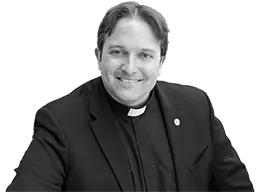
 Fr Matthew Charlesworth SJJesuit PriestSociety of JesusJesuit priest working in Southern AfricaFr. MatthewCharlesworthSJ
 Thursday of the 2nd Week of Advent
Date: | Season: Advent | Year: A
First Reading: Isaiah 41:13–20
Responsorial Psalm: Psalm 145:1, 9–13ab
| Response: Psalm 145:8
Gospel Acclamation: Isaiah 45:8
Gospel Reading: Matthew 11:11–15
Preached at: The Jesuit Institute in the Archdiocese of Johannesburg, South Africa.
This Advent word reminds us that God comes close to steady us, to lift the lowly, and to ask us whether we will make room for his kingdom in simple, costly ways.
Dear brothers and sisters in Christ, dear friends, Advent often begins more quietly than we expect. Not with trumpets, not with crowds, but with a promise spoken almost under the breath of God. Do not be afraid. I am holding your hand.
Our first reading from the Book of Isaiah is addressed to a people who feel weak and worn out. Israel is far from home, living with loss and shame, tempted to believe they no longer matter. God does not deny their fear. God answers it. I am the Lord your God, who hold your right hand. In the world of the Bible, the right hand is the hand of strength and work. God is saying, I am close enough to steady you. You are not alone in this.
Then comes the promise that feels almost too much to believe. The poor and the needy look for water and cannot find it. Their tongues are dry. God does not scold them for their need. God changes the land. Rivers in bare hills. Springs where the ground was cracked. Trees growing where nothing survived before. This is not poetic excess. It is God’s way of saying that the future does not belong to despair. Life can begin again, even here.
The Psalm today continues the same truth in calmer words. The Lord is gracious and merciful, slow to anger and rich in kindness. This is not soft language. In the ancient world, rulers were praised for power and fear. Israel praises God for patience and care. God’s kingdom lasts because it does not crush the weak. It carries them.
That matters for us now. In South Africa today, many people live with uncertainty about food, work, health, and safety. Young people wonder if their studies will lead anywhere. Families feel the weight of rising costs and fragile systems. The Scriptures do not float above these struggles. They speak straight into them. A God who brings water to dry ground asks us to notice where people are still thirsty and who is being left to struggle alone.
The Gospel from Matthew brings John the Baptist into focus. Jesus speaks with deep respect. Among those born of women there has been no one greater. John is great not because he is comfortable, but because he is faithful. He stands between promise and fulfilment. He gathers the long hope of Israel and points to Jesus without hesitation.
Jesus then says something that sounds strange at first. The least in the kingdom of heaven is greater than John. This is not an insult. It is a doorway. John belongs to the moment of preparation. He points the way but does not stay in the centre. The kingdom Jesus brings is not about status or rank. It belongs to those who are willing to receive it with open hands.
When Jesus says the kingdom suffers violence, he is not praising force. He is describing cost. Entering God’s reign means letting go of control, pride, and false safety. It means choosing change when it would be easier to stay as we are.
This is where Ignatian prayer helps us. We are invited not only to understand John, but to stand beside him. Imagine the river Jordan. The dust on his clothes. The edge in his voice. The crowds who listen and hesitate. Where are you standing? What are you afraid to release? What would repentance look like in your real life this week, not in theory?
Today the Church remembers Saint Damasus I, a pope from the fourth century. He lived at a time when the Church was divided and under pressure. Damasus believed deeply that ordinary believers needed clear access to the Word of God. He supported the work of Saint Jerome to translate the Scriptures into Latin so people could hear God speak in a language they understood. That choice shaped the Church for centuries.
Damasus did not seek novelty. He sought clarity. He knew that faith grows when the Word is close, not hidden. In his own way, he did what John the Baptist did. He pointed beyond himself, making space for Christ to be heard more clearly.
That is an Advent task for us too. In our preaching, our teaching, our conversations, our choices, do we make Christ easier to see or harder to recognise? Do we protect our comfort, or do we serve the truth with humility?
Advent does not ask us to do everything. It asks us to do something real. To hold the hand that God is already holding out to us. To notice the dry places around us. To speak the Word in ways people can understand. To let the least feel welcome in the kingdom.
The promise remains steady. I am the Lord your God. I am with you. The future is not closed. Water can still flow where the ground is hard.
As we pray with this Word this evening, let us sit with three questions.
- Where do I feel weak or afraid right now, and can I let God be close there instead of hiding it?
- Who around me is thirsty for dignity, hope, or fairness, and what simple action am I being asked to take?
- What must I step back from so that Christ, and not my own comfort, becomes clearer to others this Advent?
Source: https://sj.mcharlesworth.fr/homilies/2025-12dec-11-ya-at-02/
This homily is shared for personal and pastoral use. Please attribute the author and do not alter the meaning when quoting. If you wish this homily to be translated - there is an option on the website which will allow you to translate it into the language of your choice.
Licenced under a Creative Commons Attribution-NonCommercial-NoDerivatives 4.0 International (CC BY-NC-ND 4.0) license.
The author does not speak for the Society of Jesus or for the Catholic Church.



In preparing this homily, I consulted various resources to deepen my understanding of today’s readings, including using Magisterium AI for assistance. The final content remains the responsibility of the author.