
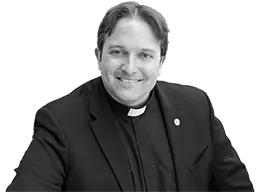
 Fr Matthew Charlesworth SJJesuit PriestSociety of JesusJesuit priest working in Southern AfricaFr. MatthewCharlesworthSJ
 Friday of the 1st Week of Advent
Date: | Season: Advent | Year: A
First Reading: Isaiah 29:17–24
Responsorial Psalm: Psalm 27:1, 4, 13–14
| Response: Psalm 27:1a
Gospel Acclamation: The Lord is my light and my help.
Gospel Reading: Matthew 9:27–31
Preached at: The Jesuit Institute in the Archdiocese of Johannesburg, South Africa.
Dear friends in Christ, today we are offered a simple truth that carries the weight of heaven: God teaches us to see again. Everything in these Advent readings leads us toward this gentle but urgent promise: our vision restored, our courage renewed, and our hearts awakened to the God who draws near to us.
Isaiah speaks first. He looks upon a people bent low by fear, deceived by leaders who traded truth for power, and he dares to imagine something new. Lebanon, once renowned for its mighty cedars, becomes in Isaiah 29 a garden, a sign that the proud will fall and the humble will flourish. Those once dismissed as foolish will understand. Those once judged as lost will listen again. And at the centre of his prophecy lies the striking image of eyes opening in the darkness. Out of gloom and shadow the blind shall see. Isaiah uses blindness not only as a physical condition but as a spiritual wound, describing a nation that could look at God’s works without wonder and hear God’s voice without change. Advent meets us in the same condition. We are not wicked, but we are weary. We are not faithless, but our faith sometimes falters. Isaiah calls us to expect restoration, not because we deserve it, but because God desires it.
The Psalm tells us that the Lord is my light and my salvation. Not my theory, not my abstraction, not my distant deity. My light. My salvation. The psalmist does not deny the darkness around him, nor the dangers that press in. Instead he anchors his courage in the One whose presence turns trembling hearts steady. He seeks one thing only: to dwell in the house of the Lord, to see the beauty of the Lord. There is that word again: see. Not stare. Not scan. See. To see as God sees. To see with a heart uncluttered by fear. Our psalm urges patient hope. Wait for the Lord. Be strong. Let your heart take courage. Advent is the school of that waiting, the quiet classroom where God teaches us how to live in light even before the sun has risen.
Then Matthew invites us into a small room in Capernaum where two blind men stand before Jesus. They have followed him by sound alone. They have shouted his royal title Son of David, recognising in him the long-awaited king whose reign would be mercy, not domination. And Jesus asks the question that Advent asks every disciple: Do you believe that I can do this? He does not ask whether they understand. He does not ask whether they deserve. He asks whether they trust. Their yes opens the way for their healing, and their healing opens their world. Their sight is restored, but so is their place in the community. In the ancient world, blindness often led to poverty, exclusion, dependence on begging. When their eyes open, their dignity rises with them. This is not a small miracle. This is a social resurrection.
Jesus warns them not to speak of it, perhaps knowing how quickly crowds can twist miracles into movements of misplaced expectation. Yet they speak anyway. They cannot hold back. Sight awakens speech. Encounter generates proclamation. Once a person has been touched by mercy they cannot quietly return to their old life.
In this moment we hear how God restores in order to reweave the fabric of community. He heals so that dignity may be honoured. He opens eyes so that no one is left unseen. In South Africa today, where many live with the strain of economic hardship, where youth face shrinking opportunities and families endure the uncertainty of rising prices and fading services, the promise of Isaiah and the compassion of Christ are not poetic comforts. They are calls to action. They summon us to become people who see the struggles around us, who refuse to walk past the hungry student, the anxious parent, the unemployed neighbour. They invite us to ask what it means, as Jesuits and as companions, to let our sight become service and our faith become justice.
Advent invites all of us into an Ignatian way of seeing. Imagine yourself in that small room in Capernaum. Feel the dust beneath your feet. Hear the breath of the two blind men as they wait for Jesus to speak. Picture the moment when their eyes open and see light for the first time in years. What expression crosses their faces? What expression crosses yours as you watch? And now hear Jesus ask you the same question he asked them: Do you believe that I can do this? Do you believe I can heal your vision, your habits, your heavy heart? Do you believe I can restore sight to a nation discouraged by hardship and to a Church sometimes tempted by fear?
The path of Advent is not passive. It is a pilgrimage of perception. To wait for the Lord is to work with him. To see as he sees is to stand where he stands. That means drawing close to those who live in the shadow of hunger, loneliness, or despair. It means speaking hope where others speak cynicism. It means believing that the garden Isaiah promised can grow even in soil that feels exhausted and dry. The kingdom begins wherever someone sees with compassion and acts with courage.
So let us walk into this season with open eyes and open hands. Let us allow the Lord to be our light, not only in prayer but in practice. Let us ask for the grace to notice the unnoticed, to hear the unheard, to love the unloved. Let us believe that Christ can do in us what he did for those two men: restore our sight and send us out as witnesses of mercy.
As you pray with these readings in the coming days, perhaps you might sit quietly and ask yourself:
- Where is Jesus inviting me to see more clearly, especially in places where I have grown used to darkness?
- What concrete act of mercy can I offer this week to someone whose dignity is at risk or whose hope is fragile?
- How is the Lord calling me, like the two healed men, to share the good news of what he has done for me, not by many words but by a life shaped by compassion?
Source: https://sj.mcharlesworth.fr/homilies/2025-12dec-05-ya-at-01/
This homily is shared for personal and pastoral use. Please attribute the author and do not alter the meaning when quoting. If you wish this homily to be translated - there is an option on the website which will allow you to translate it into the language of your choice.
Licenced under a Creative Commons Attribution-NonCommercial-NoDerivatives 4.0 International (CC BY-NC-ND 4.0) license.
The author does not speak for the Society of Jesus or for the Catholic Church.




In preparing this homily, I consulted various resources to deepen my understanding of today’s readings, including using Magisterium AI for assistance. The final content remains the responsibility of the author.