
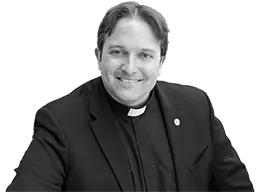
 Fr Matthew Charlesworth SJJesuit PriestSociety of JesusJesuit priest working in Southern AfricaFr. MatthewCharlesworthSJ
 Memorial of St John Damascene, priest and doctor of the Church
Date: | Season: Advent | Year: A
First Reading: Isaiah 26:1–6
Responsorial Psalm: Psalm 118:1, 8–9, 19–21, 25–27a
| Response: Psalm 118:26a
Gospel Acclamation: Isaiah 55:6
Gospel Reading: Matthew 7:21, 24–27
Preached at: The Jesuit Institute in the Archdiocese of Johannesburg, South Africa.
Dear friends in Christ, today we stand in Advent’s quiet light, listening for the steady voice that teaches us how to build a life that can stand. If there is a single thread running through the Scriptures for this Thursday of the First Week of Advent, Year A, it is this: God offers us a rock to build on, a path to walk, a city to enter, and a word to trust. Everything else is sand.
Our first reading from Isaiah sings of a city held firm by God. Isaiah speaks during a time when his people knew the terror of siege and the memory of Jerusalem falling to Babylon. Yet he paints, not ruins, but a vision of a city secure, with strong walls and open gates. The name Jerusalem means city of peace, though peace often seemed far away. Isaiah dares to proclaim that true peace is not the outcome of political victory but the fruit of trusting God. In rabbinical tradition, this section of Isaiah is sometimes called a song for the righteous, a reminder that the gates of God’s kingdom open from the inside, not by force but by fidelity. And Isaiah adds a poetic twist: this city stands strong because its foundation is not stone but trust. God himself is the bedrock.
Imagine yourself standing before those gates. Isaiah invites us to enter not with swagger but with humility, with hearts trained to depend on God rather than on restless self-reliance. For us today, where many families feel the shaking ground of economic uncertainty, where so many live between hope and hardship, this image speaks with force. We long for a secure city. God answers by calling us to become people who help build it through honesty, justice, and neighbourly care. Catholic Social Teaching reminds us that peace in the city is never only a gift; it is also a task. Every act of fairness strengthens a wall. Every gesture of compassion opens a gate.
The Psalm deepens that theme. Blessed is he who comes in the name of the Lord. It is a pilgrim’s cry, one sung by travellers approaching Jerusalem at festival time. They walked dusty roads with tired feet, but their song lifted tired hearts. The Psalmist looks at the city and sees more than stone; he sees God’s promise unfolding. Open to me the gates of righteousness. The gate is not a checkpoint. It is an invitation. And the Psalm shows us the right posture to enter: gratitude, not entitlement; humility, not presumption.
Advent is a season of longing for the One who comes in the name of the Lord, the One who walks toward us even when we are walking away. In Ignatian prayer, we often imagine ourselves in the scene. Picture yourself among the pilgrims. What burdens are you carrying? What gratitude flickers in your heart? Who stands beside you? Perhaps a neighbour struggling with school fees for her children. Perhaps an elderly friend waiting for medicine. Perhaps someone wrestling with fear of the future. Advent teaches us to carry each other as pilgrims who approach the gate together.
Our gospel acclamation gives us a crisp call: Seek the Lord while he may be found. It is not meant to suggest that God hides; rather, it urges a readiness of heart. Do not delay the good you know you are called to do. Do not postpone the healing you need or the reconciliation you can offer. In our own context, where mistrust sometimes tears neighbourhoods and families apart, this call has a particular weight. Seek the Lord now. Seek justice now. Seek each other now.
In the Gospel, Jesus is concluding the Sermon on the Mount. He knows the human temptation to admire his teaching without letting it change anything. So he draws a vivid picture. Two builders. One wise. One foolish. Both hear the same words. Both face the same storm. But one house falls because it rests on sand.
In the Hebrew Scriptures, the image of rock often points to God’s steadfastness. The Psalms repeatedly call the Lord my rock and my stronghold. When Jesus speaks of building on rock, he stands inside that tradition. To build on rock is to let God shape your inner life and your outer choices. To build on sand is to let convenience, fear, or ego become the architect.
If we enter this story through Ignatian contemplation, we might begin by imagining the sound of the wind, the smell of rain, the thud of water against the walls. We might sense our own storms in our own lives: family tensions, financial strain, discouragement in ministry, fatigue in community life. Jesus does not promise that storms will pass us by. He promises that storms will not defeat a life built on him.
And here is the heart of the matter: building on rock is not a dramatic act done once. It is made of daily choices. Listening deeply. Acting with integrity. Speaking truth with kindness. Protecting the vulnerable. Refusing corruption. Choosing the narrow path of compassion when the wide road of apathy feels easier. In our reality, where young people seek work, where elders worry about the rising cost of living, where communities carry the weight of history and hope, these choices are not abstract. They are the building blocks of a home that can stand.
Advent invites us to watch how God builds. Mary offers her yes. Joseph listens in the silence. The prophets speak with persistence. And today the Church remembers Saint John Damascene, a man who defended the truth not with anger but with clarity, patience, and courage. Living in a time of controversy about sacred images, he became a builder of understanding, showing that the Incarnation itself is God’s affirmation of the material world. In a sense, he helps us see again the solid foundation beneath our faith: Christ truly took flesh, truly entered history, truly walks our dusty roads. His life reminds us that our faith is not a dream but a dwelling, not a theory but a home to be lived in.
God offers us a rock, a path, a city, a word. Advent calls us to walk toward that city with steady steps. It calls us to anchor our lives not in the shifting sands of fear or self-preservation but in the firm ground of God’s promise. And it calls us to help each other stand when storms come, to be builders of a society that reflects God’s justice and tenderness.
May the Lord who opens the gates of righteousness open our hearts. May the peace Isaiah foretold take root in us. And may the One who comes in the name of the Lord find us building houses that stand.
Here are three questions to carry into our prayer this evening:
- Where do I sense that I have built on sand, and what invitation is God offering me to rebuild on rock?
- Which person in my life today is standing in a storm, and how might I help strengthen their foundations?
- As I imagine myself approaching the gate of God’s city, what grace do I ask for so that I may enter with a heart ready to listen and to serve?
Source: https://sj.mcharlesworth.fr/homilies/2025-12dec-04-ya-at-01/
This homily is shared for personal and pastoral use. Please attribute the author and do not alter the meaning when quoting. If you wish this homily to be translated - there is an option on the website which will allow you to translate it into the language of your choice.
Licenced under a Creative Commons Attribution-NonCommercial-NoDerivatives 4.0 International (CC BY-NC-ND 4.0) license.
The author does not speak for the Society of Jesus or for the Catholic Church.





In preparing this homily, I consulted various resources to deepen my understanding of today’s readings, including using Magisterium AI for assistance. The final content remains the responsibility of the author.