
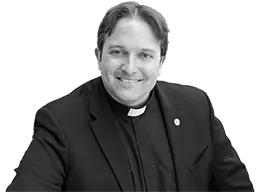
 Fr Matthew Charlesworth SJJesuit PriestSociety of JesusJesuit priest working in Southern AfricaFr. MatthewCharlesworthSJ
 Saturday of the 34th Week in Ordinary Time
Date: | Season: Ordinary Time after Easter | Year: C
First Reading: Daniel 7:15–27
Responsorial Psalm: Daniel 3:82–87
| Response: Daniel 3:59b
Gospel Acclamation: Luke 21:36
Gospel Reading: Luke 21:34–36
Preached at: The Jesuit Institute in the Archdiocese of Johannesburg, South Africa.
Dear friends in Christ, today we stand at the thin edge of a liturgical year that draws to a close, and the readings invite us to see our own lives as a landscape where God is quietly, steadily, patiently building a Kingdom that cannot be shaken. Everything that follows rests on this simple truth: God’s Kingdom grows in us when we stay awake and attentive to His presence.
Our first reading gives us a dreamer struggling to understand a troubling vision. Daniel feels his spirit faint within him as he contemplates four beasts rising from the sea, each a symbol of earthly empires that roar for a time before fading into the dust of history. The ancient rabbis often said that beasts appear when human societies forget their humanity. They saw in these creatures a warning about power without compassion, authority without accountability, rule without righteousness. Daniel watches these kingdoms come and go, but then he sees the Ancient One seated in calm, unhurried judgement, and the Son of Man receiving an everlasting dominion that will never pass away. The Hebrew phrase bar enash, meaning simply human being, reminds us that God’s true ruler is not beastlike but deeply human, the One who shows us what humanity restored looks like. In other words, our leaders should bring out the best of us.
In this moment Daniel discovers that history bends not toward chaos but toward communion. And that truth mattered to his people who lived under oppression, and it matters in our own land where many carry the weight of economic uncertainty, corruption, and the painful distance between promise and practice. In many South African communities today, trust has been strained, dignity bruised, and hope tested. Yet Daniel teaches us that the powers we fear are not forever, and that God gives the Kingdom not to the violent but to the “holy ones of the Most High”, those who, in every age, try to keep faith and live justice.
The liturgy responds with the canticle from Daniel, where the whole of creation is lifted into a great song of praise. It is as if creation itself refuses to surrender to despair. Mountains, seas, sunlight, frost, fire, and cloud become a choir reminding us that the world is more than the sum of its sorrows. The text invites us to take our place within the music of creation. In our Ignatian contemplation we might imagine ourselves standing in a desert dawn, hearing the earth breathe its hymn of blessing, and letting that serenity anchor our own turbulent hearts. The invitation is simple: remember that praise is a posture of resistance. When we praise God, we refuse to let fear write the final line of our story.
Then the Gospel from Luke speaks with the clarity of a friend taking us gently by the shoulders. Stay awake. Stand ready. Do not let your heart grow heavy with anxieties or with the distractions that dull the soul. Jesus knows how easily we drift into spiritual sleep. He knows how many hearts in our neighbourhoods feel weighed down by joblessness, the rising cost of living, the fear that tomorrow will look no different from today. Yet He does not scold us; He invites. Look up, He says. Lift your gaze. Live with the alertness of someone who expects grace at any moment.
In the language of the Spiritual Exercises, this is the call to discern the spirits, to notice what draws us toward life and what drags us toward numbness. Vigilance is not nervous waiting. It is rather a faithful attention. It is the watchman of Psalm 130 yearning for the morning. It is the student who studies late into the night because she believes her work matters. It is the parent who rises before dawn to provide for the family they cherish. It is the small parish community that refuses to let despair define them. And above all it is Christ Himself, the Son of Man, who teaches us how to stay awake. His vigilance was born of love.
Here we may think of Blessed Bernard Francis de Hoyos, a young Jesuit whose heart was set entirely on the Sacred Heart of Jesus. He lived only twenty-four years, but in those years he stayed deeply awake to the movements of grace. In prayer he heard Christ whisper the promise that Spain would be entrusted to the tenderness of the Sacred Heart, and he carried that mission with humility and courage. He was a man who noticed. A man who listened. A man who let his heart be shaped by the love that beats at the centre of the universe. Bernard shows us that staying awake is not about restless activity but about a readiness to receive God’s love and to share that love with quiet resolve.
Daniel’s vision, the canticle of creation, the Gospel’s call, and the life of our Jesuit brother all circle around a single image we should consider this: staying awake. Staying awake to God, to neighbour, to the fragile and fierce beauty of the world God has made. Staying awake so that the beasts of fear and cynicism do not steal our humanity. Staying awake because the Kingdom has already begun, and we are invited to help it grow, especially where poverty wears down dignity or where corruption erodes trust. The vigilance Jesus asks of us is lived not on mountaintops but in small, steady acts of justice, kindness, and courage.
So let us ask for the grace this evening to keep watch with hope, to act with mercy, and to walk with the confidence that the Ancient One guides history and guides us still. May the Son of Man find in each of us a heart ready for His coming. And may Blessed Bernard de Hoyos teach us how to listen for the heartbeat of Christ in all things.
As you pray this evening, consider these questions in the stillness of your own heart:
- Where has my heart grown heavy or drowsy, and what is Christ inviting me to notice again?
- Who around me needs the kind of watchful love that Jesus Himself offers?
- How might I stay awake to God’s presence in a practical way each day, even in the ordinary tasks that fill my life?
Source: https://sj.mcharlesworth.fr/homilies/2025-11nov-29-yc-ot-34/
This homily is shared for personal and pastoral use. Please attribute the author and do not alter the meaning when quoting. If you wish this homily to be translated - there is an option on the website which will allow you to translate it into the language of your choice.
Licenced under a Creative Commons Attribution-NonCommercial-NoDerivatives 4.0 International (CC BY-NC-ND 4.0) license.
The author does not speak for the Society of Jesus or for the Catholic Church.





In preparing this homily, I consulted various resources to deepen my understanding of today’s readings, including using Magisterium AI for assistance. The final content remains the responsibility of the author.